
Views: 0 Author: Site Editor Publish Time: 2026-08-30 Origin: Site
Procuring bulk material handling solutions carries incredibly high stakes. Customized packaging requires serious upfront capital. Tooling and injection molding costs often run into the hundreds of thousands of dollars. You cannot afford a mistake during procurement. Standard containers frequently fail to maximize cubic space inside trailers. They often struggle to protect specialized parts during transit. Generic bins also regularly cause jams in modern automated storage and retrieval systems (ASRS). We designed this article to provide an objective, evidence-based evaluation framework. You will learn how to determine if moving away from standard sizing yields a positive return on investment. We will show you how to structure your procurement strategy effectively. You will also learn how to execute this massive purchase without causing critical supply chain disruptions. This checklist ensures you protect your initial investment while upgrading your entire logistics network.
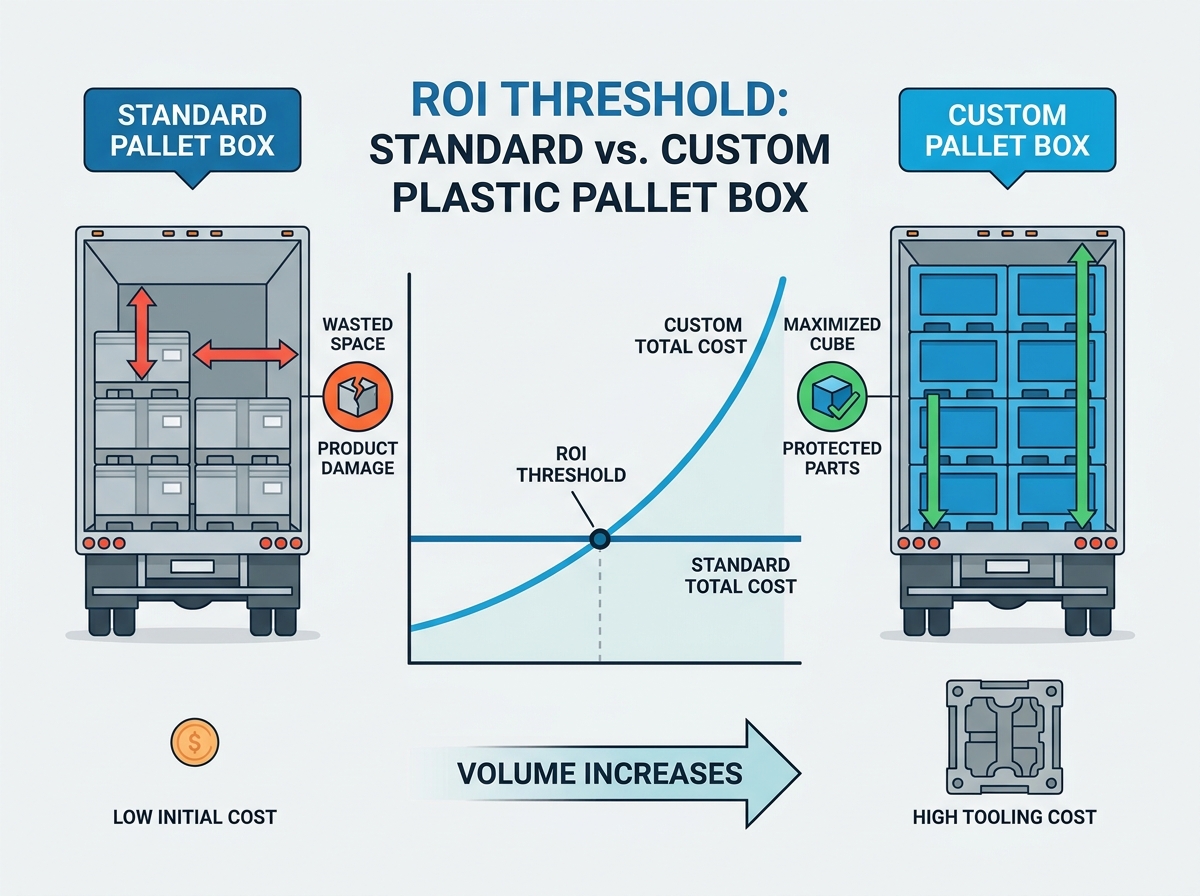
Generic storage bins dominate low-volume supply chains because they cost very little upfront. You can purchase standard boxes immediately from dozens of distributors. This quick availability works well for simple storage needs. However, generic dimensions often fail in highly specialized manufacturing environments. Standard containers routinely leave empty air inside shipping trailers. They waste valuable cubic volume. They also struggle to secure proprietary parts. Parts shift during transit. This shifting leads to catastrophic product damage. A custom plastic pallet box solves these exact problems but carries steep initial mold costs. You must justify this capital expenditure carefully.
You achieve success by calculating a precise volume tipping point. Procurement managers must measure current transit inefficiencies against the quoted tooling costs. Custom containers become highly profitable when shipping density improves. Adding just 15% more product per truckload slashes annual freight expenses dramatically. Reduced product damage also accelerates your return on investment. If specialized internal dividers prevent scratches on automotive parts, the custom tooling pays for itself rapidly. You must map these projected savings against the initial mold investment.
Logistics buyers should utilize a formal decision matrix before committing capital. We recommend categorizing your packaging needs into three distinct tiers. This categorization simplifies the purchasing strategy across different departments.
Before contacting manufacturers, you must establish strict baseline requirements. Weight capacities dictate the entire structural design process. You must define three distinct performance metrics clearly. Dynamic load measures the maximum weight the container can hold while moving on a forklift. Static load measures the absolute maximum weight allowed when stacking containers on the warehouse floor. Racking load determines how much weight the container supports when resting solely on steel pallet rack edges. Failing to calculate racking limits correctly leads to catastrophic warehouse collapses.
Design topography directly impacts your daily operations. You need to outline specific stackability requirements. Nestsability also matters immensely for closed-loop supply chains. Containers designed to nest inside one another save massive amounts of return freight space. You should also evaluate wall thickness carefully. Thicker walls survive forklift impacts better but increase the unit weight. You must balance impact resistance against ergonomic handling limits. Ensure your engineering team formalizes all custom plastic pallet box specifications early in the design phase.
Modern warehouses rely heavily on automation. Conveyor belts and optical sensors require precise container dimensions. You must specify the exact base configurations required. Common setups include 3-runner bases, 6-runner bases, or completely flat bottoms. Automated systems also demand strict deflection tolerances. If the container bottom bows downward under heavy loads, it will jam the conveyor belt. Optical sensors will fail to read barcodes if the container walls warp.
Material selection defines the operational lifespan of your containers. High-Density Polyethylene (HDPE) and Polypropylene (PP) represent the two dominant resin choices. Both offer unique advantages depending on your specific industry environment.
| Performance Metric | High-Density Polyethylene (HDPE) | Polypropylene (PP) |
|---|---|---|
| Temperature Tolerance | Excels in freezing environments. Resists cracking at sub-zero temperatures. | Excels in high-heat environments. Withstands industrial washing easily. |
| Impact Resistance | High flexibility. Absorbs forklift impacts without shattering. | High rigidity. Offers superior structural stiffness under heavy loads. |
| Compliance & Hygiene | Highly suitable for FDA/USDA food processing applications. | Ideal for pharmaceutical and clean-room manufacturing environments. |
| General Lifecycle | Long-lasting in rough external logistics networks. | Performs exceptionally well in controlled automated warehouses. |
Heavy industrial sectors face unique material handling challenges. Generic bins fail to secure high-density metallic parts effectively. Irregularly shaped items like automotive stampings or raw castings shift violently during transit. You must design specific solutions to manage these unwieldy loads. Engineers create dedicated cavities to lock heavy parts firmly in place. This prevents metal-on-metal contact. A well-designed bulk components custom plastic pallet box maximizes density while eliminating surface scratches.
Internal protection separates an average container from an exceptional one. You can integrate highly customized internal dunnage directly into the design. Molded inserts cradle delicate machinery components perfectly. Rigid dividers keep painted parts isolated from one another. You should also incorporate customized drop-doors. Deep bins cause severe ergonomic strain for warehouse staff. Drop-doors allow operators to reach the bottom without bending awkwardly. This small design feature reduces workplace injuries significantly.
Structural integrity remains a critical focus when hauling shifting loads. Flowable materials exert immense outward pressure. Powders, resins, and small metallic fasteners push aggressively against the container walls during transit. Sidewall blowouts cause massive product loss and safety hazards. We prevent this by reinforcing all corners heavily. We also upgrade hinge mechanisms on collapsible models. Thicker corner columns absorb lateral forces better. Steel-reinforced runners can also prevent the base from sagging under extreme weights.
Selecting a manufacturing partner requires intense scrutiny. Unit price represents only a small fraction of the evaluation process. You must look beyond simple cost estimates. Shortlisting partners requires a deep dive into their engineering capabilities. A strong partner offers in-house design services and material science expertise. They should act as consultants rather than mere order takers. You must assess their historical performance on similar complex projects. Demand case studies showcasing their ability to solve specific transit challenges.
Mold ownership disputes ruin many bulk procurement initiatives. You must clarify all intellectual property terms before signing any contracts. Define exactly who owns the custom mold once you pay for it. Some manufacturers try to retain ownership to lock you into long-term production contracts. Others might try to sell your proprietary design to your direct competitors. A trustworthy custom plastic pallet box supplier signs strict exclusivity agreements. They guarantee your customized footprint remains entirely proprietary to your supply chain.
Production capacity often separates boutique shops from enterprise-level partners. You must audit their factory floors carefully. Ask about their injection molding and structural foam molding machine limits. Can they handle sudden spikes in order volume? Determine their maximum monthly throughput. Bulk orders require massive resin reserves and continuous machine uptime. If your supplier relies on a single molding machine, any mechanical failure will cripple your rollout timeline.
Strict quality assurance protocols separate reliable suppliers from risky ones. You should never approve full-scale production based on digital drawings alone. Require 3D-printed prototypes first. Better yet, demand a small pilot run of physical samples. This allows your team to test the containers in actual warehouse conditions. Assess the manufacturer's ISO certifications rigorously. Ask for their batch-testing documentation. They should perform routine drop tests and compression tests on every production run. Consistent QA guarantees uniform dimensions across thousands of units.
Transforming your logistics network introduces substantial operational risks. You must acknowledge the aggressive timelines involved in customized manufacturing. Procurement teams often underestimate the engineering phase. Drafting blueprints, cutting steel molds, and testing a custom custom plastic pallet box can take 12 to 16 weeks easily. This extended timeline creates a severe vulnerability if your current packaging inventory runs low. You must plan a strategic inventory overlap. Keep ordering standard boxes until the custom units clear all final warehouse tests.
Quality fade represents a silent but destructive risk during massive production runs. Manufacturers sometimes cut corners after delivering the first flawless batch. They might introduce higher ratios of recycled resin to pad their profit margins. This degradation weakens the container walls. Dimensional warping also occurs if machines run too fast without proper cooling times. You mitigate this by writing strict tolerance acceptance criteria into the master agreement. Specify allowable variance margins down to the millimeter.
Supply chain adoption dictates the ultimate success of your new containers. A brilliantly designed box fails if your workers refuse to use it properly. You must mitigate integration friction early.
Upgrading your logistics network requires methodical planning and uncompromising standards. You must start by defining your exact dimensional and weight requirements. Then, calculate your ROI threshold accurately. Map your transit savings against the initial tooling costs to justify the capital expenditure. Treat the supplier vetting process as an ongoing partnership evaluation rather than a simple transaction. Demand transparency regarding mold ownership and insist on rigorous QA batch testing. Prepare your warehouse staff for the transition well in advance.
Tooling and molding fees demand a heavy upfront investment. However, the long-term operational savings remain easily verifiable. You eliminate wasted trailer space. You stop internal product damage completely. You ensure seamless integration across your entire automated warehouse grid. Taking control of your packaging dimensions transforms an unpredictable supply chain into a highly optimized asset.
Your next step requires gathering precise field data. Walk your warehouse floor and document your current container failure points. Reach out to a qualified engineering team immediately. Request a comprehensive material-handling audit. Ask them to provide a detailed tooling estimate based on your specific transit challenges. Do not commit to a final design until you hold a physical prototype in your hands.
A: The entire process typically takes 12 to 16 weeks. Quoting and engineering design usually consume 2 to 3 weeks. Cutting the steel mold takes the longest, averaging 6 to 8 weeks. Prototyping and testing add another 2 weeks. Final bulk production and delivery round out the remaining timeline.
A: Yes. You can avoid expensive mold fees by using modified standard bins. Suppliers can add customized internal dunnage, molded inserts, or rigid dividers to existing standard footprints. This semi-custom approach protects irregular parts perfectly while saving hundreds of thousands in upfront tooling costs.
A: Custom designs lack the historical performance data of standard bins. Therefore, they require bespoke Finite Element Analysis (FEA) testing before manufacturing begins. Engineers use FEA to simulate dynamic forklift movements and static racking loads digitally. This guarantees the new geometry will not collapse under specified weight limits.
A: Absolutely. Custom units molded from high-density polyethylene (HDPE) or polypropylene (PP) remain 100% recyclable. Many reputable suppliers offer structured buy-back or regrind programs. They will take back your broken or expired containers, grind them down, and use the resin to mold your next generation of boxes.

