
Views: 0 Author: Site Editor Publish Time: 2026-09-10 Origin: Site
Evaluating a single prototype on a quiet conference room table rarely reflects operational reality. It will never show how the container actually performs under heavy, dynamic loads in a fast-paced warehouse environment. Procurement teams face intense pressure during this decision stage. Selecting the wrong container often leads to disastrous operational consequences down the line. You might face frequent conveyor jams. Your teams could experience severe product damage. You will likely incur compounded replacement costs from early container failures. To make an evidence-based procurement decision, supply chain managers must evaluate samples through a rigorous testing framework. We will guide you through testing structural integrity and confirming true workflow compatibility. You will learn how to accurately verify specifications against your existing infrastructure. We will also show you how to objectively measure overall supplier reliability before signing any mass-production contract.
You cannot rely on subjective opinions when comparing multiple container samples. Procurement teams must establish strict baseline metrics. You should frame your entire evaluation around three core pillars. First, verify exact dimensional tolerances. Automated conveyor systems have zero tolerance for bulging base walls. Second, measure the true tare weight. Heavy containers limit your overall freight capacity during transport. Third, test the maximum load capacity under continuous strain. You must cross-reference all physical measurements against the provided stackable logistics box specifications carefully. Any deviation between the spec sheet and the physical sample is a major red flag.
Next, evaluate regional standardization compatibility. Global supply chains rely on strict footprint dimensions. For example, you must verify if an eu box sample truly meets Euro pallet requirements. It must fit the standard 1200x800mm footprint perfectly. Even a tiny two-millimeter overhang causes severe palletizing issues. It also risks catastrophic load collapses during transit. You should physically place the sample onto your standard pallets. Confirm the interlocking fit yourself.
Temperature and environmental ratings require equal scrutiny. Manufacturers often state broad operating temperature ranges. You must assess these claims against your daily reality. Cold storage environments make certain plastics highly brittle. High-heat transit routes cause base warping. You cannot blindly trust a vendor's specification sheet. Manufacturers test their products in highly controlled laboratories. Your warehouse is a chaotic, dynamic environment. Specifications must be rigorously validated through your own facility's operational lens.
| Evaluation Metric | Testing Method | Acceptable Tolerance |
|---|---|---|
| Dimensional Accuracy | Digital caliper measurement | ± 2.0 mm maximum |
| Tare Weight Variance | Industrial scale weighing | ± 1.5% from spec sheet |
| Standard Pallet Fit | Physical placement on Euro pallet | Zero external overhang |
| Extreme Temp Resilience | 24-hour commercial freezer exposure | No visible cracking or warping |
Visual inspections provide very little value. You must execute aggressive physical tests on the prototype. Detail a clear plan for static versus dynamic load testing. Stacking five empty boxes together proves absolutely nothing. Instead, you must test a fully loaded bottom unit. Fill the sample to its maximum weight capacity. Stack identical loaded units on top. Leave this column standing for 72 hours minimum. You must then inspect the bottom unit for bowing walls. Check the base for any structural deflection. Dynamic load testing is equally critical. Move the loaded boxes using your standard forklifts. Observe how the container handles sudden stops and sharp warehouse turns.
Material selection criteria dictate long-term survival. You must compare the rigidity of virgin plastics against recycled alternatives. Virgin High-Density Polyethylene (HDPE) offers superior impact resistance. Recycled Polypropylene (PP) might reduce upfront costs significantly. However, recycled materials often sacrifice essential structural rigidity. They degrade much faster in volatile environments.
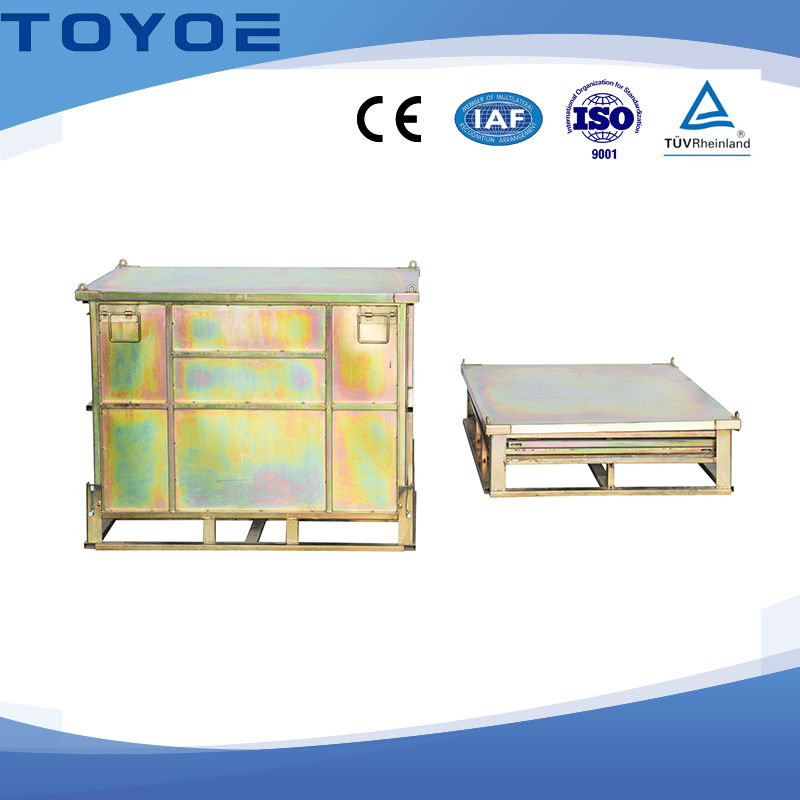
Industrial applications frequently push plastics beyond their breaking point. Dense automotive parts easily shatter standard plastic walls. Heavy manufacturing components destroy base ribs. In these extreme industrial use cases, plastic simply fails. You must recognize when to pivot away from polymers entirely. Upgrading to a sturdy metal pallet box heavy duty alternative prevents catastrophic failures. Metal containers easily absorb massive dynamic shifts. They secure incredibly dense loads safely.
You must actively inspect all wear and tear vulnerabilities. Every container features distinct high-stress points. Focus your inspection on these specific areas:
Look closely for material thinning in these zones. Inspect the edges for molding defects. We refer to these sharp protrusions as flashings. Flashings indicate extremely poor manufacturing control.
Space utilization directly dictates your logistics efficiency. You must compare the exact return-logistics footprint. Evaluate the stacking versus nesting efficiency carefully. Straight-stacking boxes offer sheer vertical stability for heavy loads. However, they consume massive amounts of space during return transit. Stack-and-nest designs solve this problem efficiently. You must calculate the exact nesting ratio if the sample features a nestable design. A high nesting ratio frees up critical trailer space. It reduces the number of required return shipments.
Automated handling readiness is another mandatory check. You must evaluate the sample's base design meticulously. Smooth bases glide seamlessly on belt conveyors. Ribbed bases grip automated rollers much better. You must test the sample against your specific Automated Storage and Retrieval Systems (ASRS). Modern ASRS sensors are highly sensitive. They will instantly reject a container displaying even minor base deflection. Run the loaded prototype through your live conveyor loops. Watch for sensor blind spots or mechanical jamming.
Worker safety and ergonomics cannot be ignored. Manual handling injuries paralyze warehouse productivity. Assess the overall grip comfort. Lift the loaded sample manually. Evaluate the vertical weight distribution. Poorly designed handles cause severe repetitive strain injuries over time. You must also evaluate the risk of pinch points. Inspect the locking hinges on collapsible models. Workers must be able to collapse the units swiftly. They should never risk crushing their fingers during fast-paced shifts.
A prototype represents a manufacturer's best possible effort. It serves as their premier sales tool. You must approach the prototype inspection as a highly skeptical buyer. If a hand-picked sample displays defects, mass production will amplify these issues tenfold. Look closely for inconsistent molding or poor welding. Check the interior walls for color streaking. Color streaking signals improper material mixing during injection. Watch out for sharp plastic edges. They will quickly damage delicate goods. They will also repeatedly injure your warehouse staff.
Stacking mechanism failures demand immediate rejection. You must test the interlocking mechanism aggressively. A reliable stackable logistics box prevents dangerous warehouse accidents. The base must lock into the top rim of the lower box seamlessly. If the mechanism requires excessive manual force to engage, reject it. Workers will not fight stubborn locks during a busy shift. They will simply leave them unstacked. Furthermore, test the vertical stability. Build a column three units high. Push the top unit gently. If the stack wiggles or leans, it is a critical safety hazard.
Common mistakes during prototype evaluation include:
Always document every single flaw. Photograph the defects immediately. Share these findings with your procurement committee.
A flawless physical sample is practically useless if the manufacturer lacks operational maturity. The prototype must serve as a gateway to audit the entire company. You must thoroughly evaluate the stackable logistics box supplier before advancing. Check their true scalability. Can they actually meet your high volume requirements? Ask about their production capacity during peak seasons. Verify their guaranteed lead times. A great box delivered three months late disrupts your entire supply chain.
Demand complete Quality Assurance (QA) transparency. Do not settle for marketing brochures. Ask the vendor for their internal QA data. Request the specific batch report for your provided sample. You want to see their Melt Flow Index (MFI) test results. Honest, authoritative manufacturers share this data freely. Evasive answers indicate poor internal quality control.
Evaluate their customization capabilities thoroughly. Standard boxes rarely fit specialized operations perfectly. Your facility might require integrated RFID tags. You might need custom internal dunnage for fragile components. Some environments require specific drainage holes for cleaning. Ask the supplier about these modifications upfront. Evaluate their transparency regarding custom tooling fees. Assess how these necessary modifications will impact the revised lead times. A reliable partner collaborates on engineering challenges. A poor supplier simply inflates the invoice.
A physical sample is an audition for long-term operational integration. You are not just buying plastic or metal. You are investing in daily warehouse efficiency. You must enforce a rigid, objective evaluation matrix. Test every sample under grueling static and dynamic loads. Verify all dimensions against your automated conveyor systems. Never ignore minor prototype defects, as mass production will only make them worse. Validate the manufacturer's scalability and quality assurance transparency.
Your next step is simple but critical. Never sign a full mass-production contract based on a few samples. Advise your procurement team to request a limited "pilot batch" first. Procure 50 to 100 units. Run a live-environment trial in your facility for thirty days. Document every performance metric and failure point. This pilot phase secures the empirical data needed to finalize a smart, risk-free procurement contract.
A: A minimum of 3 to 5 units is absolutely required. One box is highly insufficient. You need multiple units to properly test the interlocking mechanism. You must also evaluate vertical weight distribution accurately. Multiple units allow you to calculate the true nesting efficiency in a return stack.
A: Acceptable tolerances align with standard VDA/KLT guidelines. They generally fall within a few millimeters. Strict dimensional accuracy prevents any overhang on standard Euro pallets. It also ensures seamless compatibility with automated conveyor systems and robotic handling equipment.
A: You must use accelerated practical workarounds. Execute drop tests at maximum load capacity. Expose the sample to extreme temperatures in a commercial freezer for 24 hours. You should also meticulously review third-party ISO certification data to validate the supplier's long-term material claims.

