
Views: 0 Author: Site Editor Publish Time: 2026-08-12 Origin: Site
Supply chain managers and packaging engineers face massive pressure today. They must aggressively lower operational expenses while hitting strict sustainability mandates. Moving away from single-use packaging to Returnable Transit Packaging (RTP) creates complex logistical challenges. This shift requires materials balancing extreme structural integrity and very low tare weight. Traditional solid plastics often add too much unnecessary bulk. Standard corrugated cardboard degrades far too quickly during demanding transit cycles.
While wood, solid plastic, and heavy-duty corrugated board have historical dominance, polypropylene structures are rapidly replacing them in long-loop logistics. This guide breaks down the essential technical and financial criteria you need. You will discover exactly how to evaluate this versatile material for industrial reusable packaging applications. We explore critical performance metrics, specification strategies, and actionable procurement steps.
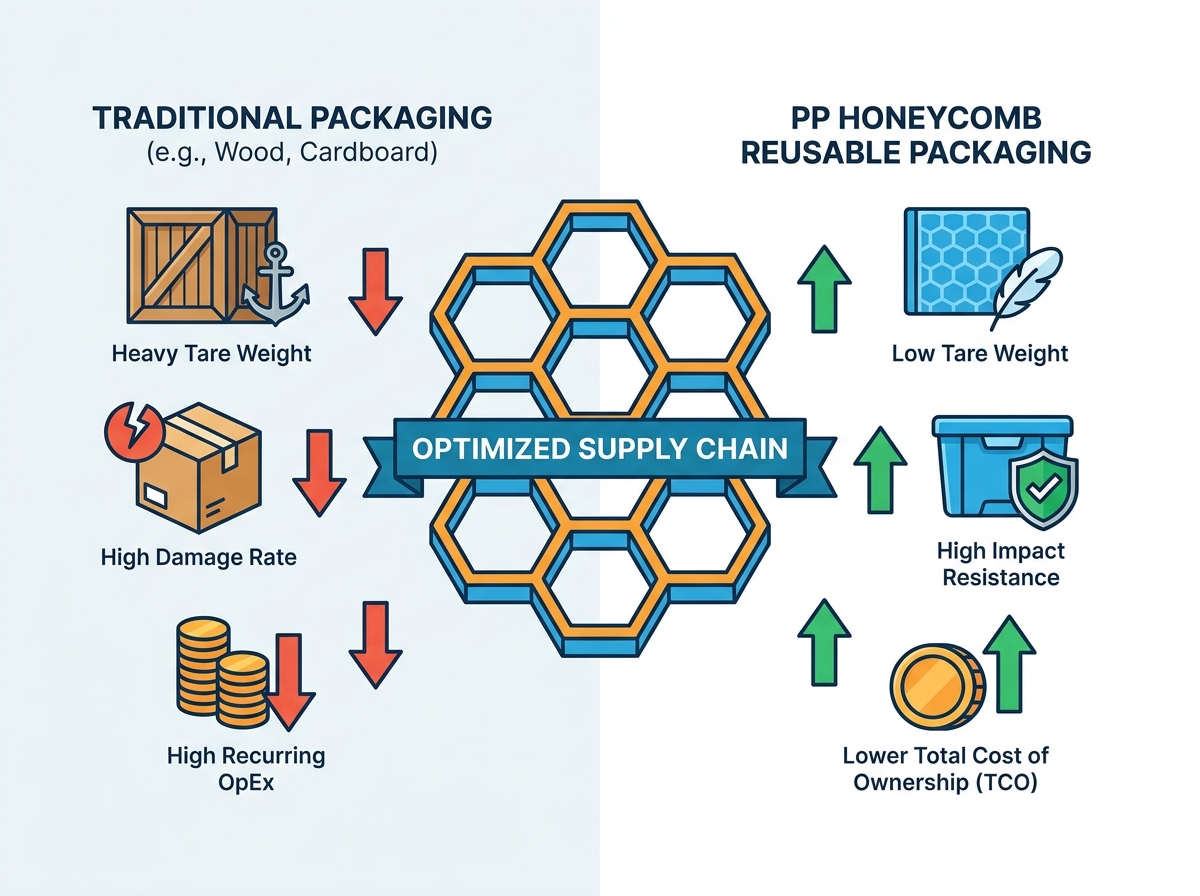
Adopting advanced materials requires a clear financial justification. Switching from single-use corrugated boxes to a reusable packaging PP honeycomb panel transforms packaging from a disposable expense into a long-term operational asset. We must analyze both upfront investments and ongoing savings.
You will face a higher initial capital expenditure (CapEx) when purchasing plastic honeycomb structures. Corrugated cardboard costs less on day one. However, corrugated boxes incur recurring operational expenditures (OpEx) because you must constantly replace them. A well-designed polypropylene unit reaches its break-even point typically within 10 to 15 transit cycles. After clearing this threshold, every subsequent trip generates direct cost savings.
| Metric | Single-Use Corrugated Box | PP Honeycomb Reusable Unit |
|---|---|---|
| Initial CapEx | Very Low | Moderate to High |
| Lifespan (Trips) | 1 - 2 cycles | 50 - 100+ cycles |
| Replacement Frequency | Continuous | Minimal (Years) |
| Estimated Break-Even | N/A | 10 - 15 cycles |
Weight directly influences logistics expenses. The hollow cellular structure of a honeycomb board drastically reduces packaging tare weight. Lighter packaging lowers the vehicle's gross weight. This maximizes your payload capacity, allowing you to ship more product per truckload. Furthermore, reduced transport weights translate directly into lower fuel consumption and decreased carbon emissions. This helps companies meet aggressive green logistics goals.
Transit damage destroys profit margins. Cardboard crushes easily under heavy dynamic loads. Wood splinters and transfers shock directly to the product. Polypropylene honeycomb possesses exceptional high impact resistance and compressive strength. The hexagonal cells compress slightly under severe impacts, absorbing kinetic energy. This shock-absorbing characteristic minimizes product loss during rough transit phases.
Waste management fees eat into supply chain budgets. Mixed-material packaging often ends up in landfills. Polypropylene is 100% recyclable. When a PP honeycomb panel finally reaches the end of its usable life, you can recycle it completely. This circular economy advantage eliminates costly landfill disposal fees and supports enterprise sustainability targets.
To justify a material change, you must benchmark new options against legacy materials. Each traditional material presents distinct operational vulnerabilities.
Cardboard fails rapidly in damp environments. High-humidity logistics or cold-chain environments cause paper fibers to absorb moisture, leading to instant structural degradation. A stacked cardboard pallet will collapse if exposed to heavy condensation. Polypropylene honeycomb remains entirely inert. It is water-resistant and does not lose compressive strength in high humidity. You can easily wash and sanitize it for continuous reuse.
Solid plastic dunnage and solid pallet sleeves offer great durability but introduce major weight issues. They create ergonomic lifting risks for warehouse workers. Heavy packaging slows down manual handling processes. Honeycomb architecture provides comparable rigidity at a fraction of the weight. This material efficiency resolves ergonomic hazards without sacrificing the structural integrity needed for stacking.
Wood absorbs moisture and harbors destructive pests. International shipping requires strict ISPM 15 fumigation or heat treatment for all wooden pallets and crates. This adds administrative delays and processing fees to every export shipment. Polypropylene is exempt from all phytosanitary regulations. It bypasses international customs delays effortlessly. Additionally, it presents no splintering hazards, protecting both delicate products and human workers.
| Feature | Corrugated Paper | Solid Plastic | Wood/Plywood | PP Honeycomb |
|---|---|---|---|---|
| Moisture Resistance | Poor | Excellent | Poor | Excellent |
| Ergonomic Weight | Excellent | Poor | Poor | Excellent |
| ISPM 15 Exempt | Yes | Yes | No | Yes |
You cannot buy industrial plastic sheets blindly. Packaging engineers must evaluate strict PP honeycomb panel specifications to guarantee safety. Matching the material properties to your dynamic load requirements prevents catastrophic packaging failures.
Always request a physical technical datasheet before committing to a specification. Verify the exact GSM rather than relying solely on the thickness measurement. A common mistake is ordering thick panels with minimal GSM to save money, which often leads to severe crushing during warehouse stacking.
Standard off-the-shelf sheets work well for basic layer pads. However, complex logistics networks often demand a custom PP honeycomb panel. Tailoring the material guarantees optimal performance in specialized environments.
Hollow cells can trap dirt, water, and debris if left exposed. Edge sealing is a mandatory customization for hygienic environments. Food and pharmaceutical logistics require completely sealed perimeters. Thermal edge sealing prevents bacterial ingress and makes the panels suitable for automated high-pressure washing systems.
Standard plastics generate static electricity through friction. This static ruins sensitive electronic components like circuit boards and automotive sensors. You must request custom anti-static additives during the extrusion process. ESD-safe honeycomb boards safely dissipate static charges, protecting high-value tech freight.
Return logistics cost money. You do not want to pay to ship empty air. Custom CNC routing and thermal scoring allow rigid panels to fold seamlessly. This process transforms stiff boards into collapsible pallet sleeves or collapsible bulk boxes. A high folding ratio drastically optimizes return-leg freight costs.
Raw plastic surfaces can scratch delicate painted items. You can request custom surface laminations bonded directly to the panel during manufacturing. Evaluating the addition of EVA foam, spunbond fabrics, or non-woven linings is crucial. Automotive manufacturers use these soft-touch linings extensively to prevent scratching painted Class-A automotive parts.
Your packaging is only as reliable as your manufacturing partner. Partnering with a qualified PP honeycomb panel supplier minimizes systemic supply chain risks. You must audit their capabilities rigorously.
You must guide your procurement buyers to verify the supplier's exact material mix. Some manufacturers use high percentages of recycled PP to lower costs. While this is eco-friendly, excessive recycled content can compromise batch-to-batch structural consistency. High recycled ratios often reduce impact resistance, leading to cracked boxes during forklift handling. Demand transparency regarding their virgin-to-recycled resin ratios.
A reliable supplier does more than just extrude plastic. They should offer comprehensive CAD design and rapid sample production. You need real-world prototypes. This allows you to perform critical drop-testing, vibration analysis, and compression testing before approving mass production. Skipping the prototyping phase is a major operational mistake.
Automated packaging lines require exact dimensions. Outline acceptable industry tolerances for sheet flatness, thickness consistency, and dimensional accuracy. If a panel varies by more than a few millimeters, it will jam robotic assembly machines or fail to lock into modular pallet bases. Ensure your supplier utilizes automated quality control scanners on their extrusion lines.
Assess the supplier's total production capacity. Evaluate their extrusion line volume and their geographical logistics. You need to ensure they can scale up rapidly. When your enterprise initiates a large-scale rollout of returnable containers, your supplier must meet the sudden surge in demand without missing delivery windows.
Reusable packaging built from PP honeycomb offers a verifiable pathway to optimize your supply chain. It drastically reduces freight costs by minimizing tare weight. It eliminates the single-use waste associated with endless cardboard purchases. Furthermore, its exceptional impact resistance protects high-value transit goods from warehouse handling damage.
To successfully integrate this material, take the following actionable next steps:
A: A well-designed unit typically lasts between 50 and 100+ transit cycles. The exact lifespan depends heavily on handling abuse, forklift impacts, and environmental factors. Proper warehouse training and avoiding extreme point-loads can extend the operational life significantly.
A: Individual crushed cells within a sheet cannot be repaired. However, entire panels used in modular pallet sleeve systems are easily replaceable. If a forklift punctures one side of a sleeve, you can simply swap out that specific panel without replacing the entire packaging unit.
A: Standard industrial panels are not. To achieve direct food contact compliance, you must specifically request FDA-approved virgin polypropylene resins. Additionally, the panels must feature fully sealed edges to prevent food particles and bacteria from accumulating inside the hollow cells.
A: Standard off-the-shelf sizes usually have very low MOQs. However, requesting a custom thickness, unique GSM, or specific color requires halting and recalibrating the extrusion line. Suppliers typically require higher MOQs (often measured in tons or thousands of square meters) to justify custom extrusion runs.

