
Views: 0 Author: Site Editor Publish Time: 2026-08-03 Origin: Site
Incorrect packaging sizing in the fast-paced automotive industry carries massive logistical risks. Supply chain disruptions cost manufacturers thousands of dollars every single minute. It frequently leads to compromised part integrity and rejected shipments at the strict OEM level. Improperly sized containers also waste valuable cube space in shipping trailers. Tier 1 and Tier 2 suppliers urgently need reliable solutions to transport complex components safely across borders. We consistently see the composite pallet box serving as the preferred choice in modern supply chains. They provide an incredibly high strength-to-weight ratio, long-term durability, and smart foldability for reverse logistics. Packaging engineers and logistics managers must properly evaluate these bins before actively procuring them. This article provides a comprehensive technical evaluation framework for determining precise sizing requirements. You will learn exactly how to configure your packaging specifications to optimize automotive logistics flows and protect valuable parts.
Standard packaging often fails strict automotive OEM tolerances. Off-the-shelf boxes routinely max out freight weight prematurely. They leave vertical trailer volume entirely empty. Precision sizing solves this widespread problem directly. It allows engineers to balance physical container weight against internal carrying capacity. We call this optimizing the cube-to-weight ratio.
Precise external sizing directly impacts container density. You lower your per-unit freight costs when you maximize trailer space. North American logistics heavily rely on 53-foot trailers. Global automotive supply chains rely on standard 40-foot high-cube sea containers. If your bins sit just one inch too wide, you lose an entire row of pallets. This tiny miscalculation slashes your transportation efficiency significantly. Precision sizing ensures every available inch of trailer real estate performs useful work.
Automotive parts require extreme care during transit. You risk part-to-part contact if internal dimensions do not perfectly match component nesting guidelines. Parts shift during heavy braking or ocean turbulence. Micro-scratches on a Class-A surface panel lead to instant OEM rejections. Precise sizing secures the internal dunnage tightly. It eliminates void spaces completely. This secure fit complies with strict Tier 1 handling manuals. It ensures parts arrive line-side exactly as they left the manufacturing facility.
Defining specifications requires a highly systematic approach. You must evaluate external footprints first. Then, you calculate internal volumes. Finally, you assess the folding ratio for return trips. Each step requires accurate data from your logistics network.
Your external footprint must match your destination region. Automated guided vehicles (AGVs) and standard forklifts demand specific fork pocket placements. If you ignore regional standards, your warehouse automation fails.
| Logistics Standard | Standard Dimensions | Primary Region | Application Notes |
|---|---|---|---|
| AIAG Standard | 48" x 45" | North America | Designed for standard automotive trailer nesting. |
| Euro Pallet (EPAL) | 1200 x 800 mm | Europe | Optimal for high-density warehouse racking storage. |
| ISO Global Container | 1200 x 1000 mm | Asia / Global | Maximizes ocean freight cube utilization precisely. |
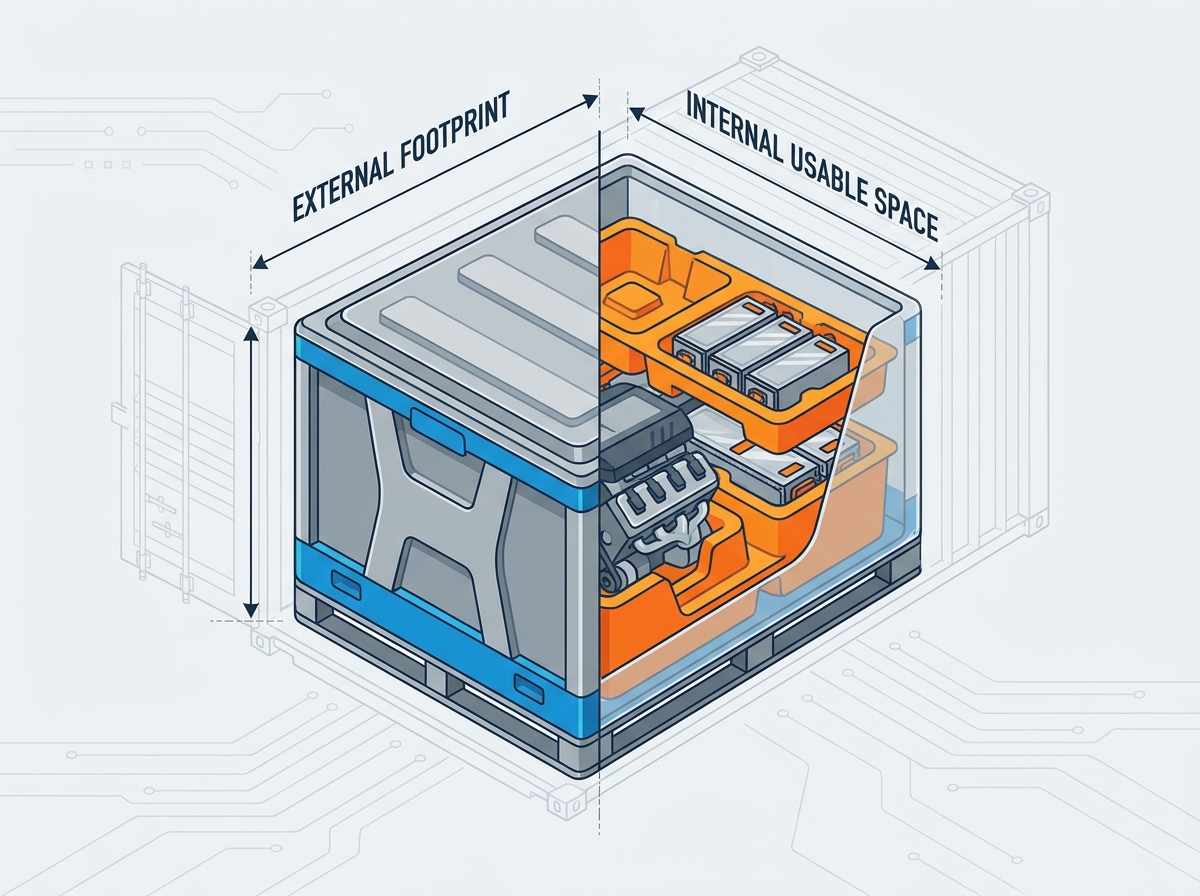
Do not confuse external dimensions with internal usable space. Wall thickness consumes valuable space. Reinforcing ribs eat into your internal capacity. You must calculate the actual working volume carefully. Packaging an automotive parts composite pallet box often requires additional inserts.
Reverse logistics consume a large portion of your budget. Returnable transit packaging (RTP) must collapse efficiently. You need to evaluate the collapsed height thoroughly. A high folding ratio minimizes return freight costs substantially. Most modern designs aim for a 3:1 or 4:1 return ratio. This means you can return four empty boxes in the exact space of one fully assembled unit. Better ratios drive faster lifecycle payback periods.
You cannot use a one-size-fits-all approach for load ratings. Automotive parts vary wildly in density. Evaluating static, dynamic, and racking limits prevents catastrophic packaging failures.
Engine blocks, transmissions, and brake rotors present unique challenges. They pack massive weight into small footprints. You must size for high-density components meticulously. Dynamic load capacity defines the maximum in-transit weight during transport. Static load capacity dictates how high you can stack bins safely inside a warehouse. Heavy-duty applications prioritize high dynamic ratings above all else.
The electric vehicle revolution changes packaging rules entirely. EV battery modules and complex electronics require different considerations. They may feature lower overall weights. However, they demand stricter structural rigidity. A bending pallet box flexes the battery module inside. This flex damages sensitive internal cell structures. You must select options featuring reinforced steel tubes inside the plastic base. This prevents flex entirely.
| Packaging Feature | Traditional Auto Components | NEV / EV Components |
|---|---|---|
| Weight Density | Very High (Castings, Metals) | Medium to High (Batteries) |
| Structural Rigidity | Moderate (Parts handle flex well) | Extreme (Zero flex allowed) |
| Material Additives | Standard UV and Impact Resistance | Flame Retardant (FR) & Anti-Static |
| Typical Dunnage | Rigid plastic trays, heavy foam | Textile pouches, ESD-safe foam |
Warehouses utilize edge-racking systems extensively. You must verify deflection limits carefully. A fully loaded bin resting on two beams will sag over time. This creep phenomenon weakens the structure over several months. Always request long-term deflection test data for your specific target weight.
Standard boxes cover most supply chain needs easily. Sometimes, specific parts break standard rules completely. You must recognize the triggers for custom solutions early.
Certain components simply do not fit standard grids. Unusually long steering columns present sizing nightmares. Sensitive, bulky wire harnesses tangle easily in standard bins. Oversized body panels exceed normal footprint boundaries entirely. These triggers justify moving toward a custom composite pallet box design. Custom sizing guarantees zero wasted space and maximum part protection.
Customization goes beyond physical dimensions. You must factor in material chemistry. Electronic control units (ECUs) require Anti-Static (ESD) properties. Standard plastics generate static electricity during transport. This static destroys microchips instantly. Furthermore, EV battery transport often requires Flame Retardant (FR) polymers. Modifying the polymer blend sometimes alters the shrinkage rate during manufacturing. You must adjust your final sizing tolerances accordingly when using specialized additives.
Customization requires upfront tooling investments. Custom injection molding or structural foam molds cost significant money. You must weigh these initial expenses carefully. Compare them against the long-term lifecycle savings within a closed-loop supply chain. Custom boxes last for years. They eliminate disposable packaging waste entirely. They reduce damage claims to near zero. These operational savings usually offset the tooling costs within the first eighteen months of implementation.
Your packaging succeeds or fails based on your manufacturing partner. Evaluating a partner goes far beyond negotiating a unit price. You need extensive engineering support.
Ensure the supplier thoroughly understands Tier 1 packaging manuals. They must know AIAG guidelines intimately. If they ignore these rules, the end-user will reject your shipments. A competent partner actively guides you through compliance requirements. They spot design flaws long before production begins.
Never buy hundreds of bins based on a drawing alone. Look for suppliers offering small sample runs. They should conduct rigorous in-house testing. Drop tests ensure the corners survive forklift mishandling. Vibration tests simulate rough truck rides. Compression testing proves the bins can stack safely in a warehouse. Review their composite pallet box specifications document to ensure their test parameters match your reality.
Evaluate your target composite pallet box supplier on their absolute production capacity. Check their lead times closely. Verify their minimum order quantities (MOQs) for specialized or customized runs. They must guarantee long-term material consistency across multiple batches. Color shifts or weight variances between batches indicate poor quality control.
Move your evaluation from theory into practice quickly. Take these actionable steps to finalize your supplier selection.
Right-sizing automotive packaging demands a delicate balancing act. You must align part protection, freight optimization, and material handling compatibility perfectly. Standard boxes work well for generic components. However, complex NEV parts and oversized assemblies often require specialized footprints. Do not finalize any external dimensions without first simulating your exact internal dunnage requirements. Furthermore, always assess your reverse logistics loop to verify folding ratio efficiency. Taking shortcuts during the sizing phase guarantees expensive supply chain bottlenecks later. We strongly recommend consulting with an engineering-led supplier early in your product development cycle. Request a physical prototype today. Conduct a rigorous cube-utilization audit for your specific automotive components to ensure peak logistical efficiency.
A: Standard manufacturing tolerances for large plastic molding usually range between ±1% to ±2%. Shrinkage occurs as the polymer cools after injection. You must factor in a slight dimensional buffer when sizing custom dunnage. This small buffer guarantees your automotive parts fit easily without forcing them into warped spaces.
A: Composite options offer massive weight-saving benefits. They improve worker ergonomics significantly and reduce outbound fuel costs. Steel bins offer higher maximum payload capabilities and extreme abuse resistance. However, composite boxes will not rust, they dampen transit vibrations better, and they fold flat more efficiently for return logistics.
A: Yes, they are highly sustainable. Reputable suppliers use high-density polyethylene (HDPE) or polypropylene (PP). Both materials are 100% recyclable. Many manufacturers offer closed-loop recycling programs. They will grind down your damaged or end-of-life boxes and mold them into brand new packaging units.

