
Views: 0 Author: Site Editor Publish Time: 2026-08-17 Origin: Site
Supply chains are rapidly shifting from expendable wood and corrugated containers to reusable plastic bulk solutions. Wood splinters easily, absorbs destructive moisture, and frequently harbors unwanted pests. Plastics eliminate these persistent issues entirely. However, not all plastics are created equal. Choosing the wrong polymer often leads to premature cracking, dangerous racking failures, or severe regulatory compliance breaches.
While initial price tags clearly matter, your purchasing decisions must prioritize long-term operational efficiency and overall return on investment. A failing container directly disrupts automated conveyor lines, damages highly valuable inventory, and causes immensely expensive facility downtime. Our primary goal here is straightforward. We want to transition you from casually browsing generic product pages to confidently defining exact material requirements for your procurement shortlist. By understanding the distinct chemical and structural properties of modern polymers, you can seamlessly select the right plastic pallet box for your specific facility environment. Let us dive deep into the core materials dominating the industrial market today.
Material failure carries severe and often hidden financial costs. Incorrect polymer selection directly impacts the entire supply chain ecosystem. Imagine a large bulk container holding hundreds of liters of industrial liquid. Hydrodynamic pressure continuously pushes outward against the walls. If the plastic flexes too easily, the container walls bow outward. This bowing exceeds the standard pallet footprint, severely complicating truck loading and wasting valuable trailer space.
Consider the impact on an Automated Storage and Retrieval System (AS/RS). These highly precise automated systems rely on lasers and optical sensors. If a container's base deflects by even a single inch under heavy loads, the sensors misread the position. This triggers immediate system shutdowns. Sorting out a jammed AS/RS system costs thousands of dollars per hour in lost productivity.
Before evaluating specific materials, buyers must strictly map out their baseline operational criteria. Consider these environmental factors carefully:
Lifespan expectations also hinge entirely on your material choice. Premium, correctly specified plastics exhibit a highly predictable, slow degradation curve. You can financially plan for their eventual retirement over several years. Conversely, low-grade alternatives or mismatched polymers suffer sudden, catastrophic failures. Such unpredictable breakages destroy your return on investment and continuously disrupt daily logistics.
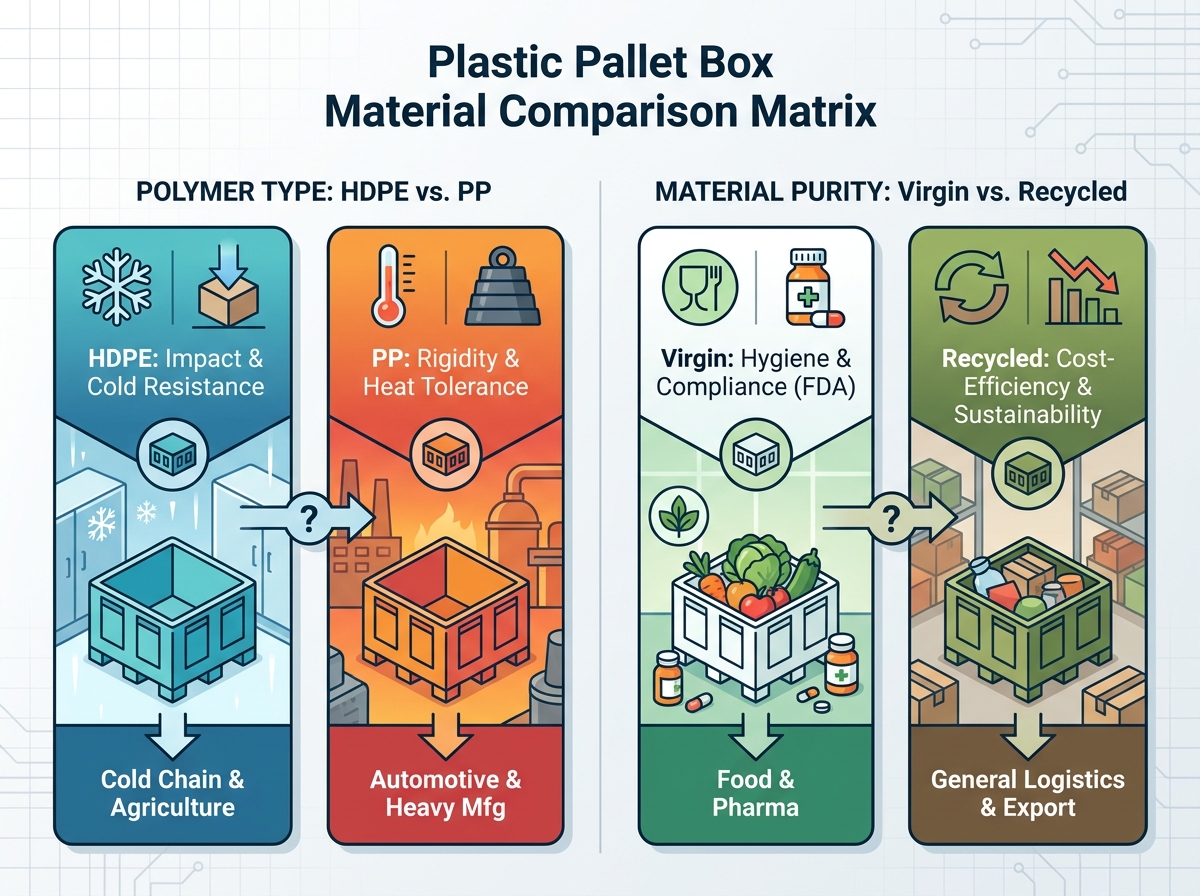
Most industrial bulk containers rely on two primary polymers. Understanding their distinct molecular advantages ensures you avoid costly misapplications.
High-Density Polyethylene stands out as the most ubiquitous polymer choice in material handling. Its linear molecular chain structure grants it incredible toughness.
Strengths: HDPE boasts exceptional impact resistance. It absorbs kinetic energy incredibly well during accidental forklift impacts or rough handling drops. Furthermore, it performs flawlessly in sub-zero environments. It resists becoming brittle even at freezing temperatures. This resilience makes HDPE the undisputed champion for cold chain logistics, agricultural harvesting, and frozen food processing operations.
Limitations: HDPE experiences slightly higher flex under extreme static loads compared to its rigid counterparts. If you leave an extremely dense load sitting in an HDPE container for months, you might observe minor bowing along the unsupported sidewalls.
Polypropylene serves as the heavy-duty counterpart to HDPE. It perfectly caters to industrial environments demanding absolute structural stability and minimal flex.
Strengths: PP provides significantly higher tensile strength and exceptional rigidity. It holds its shape perfectly under massive loads. Additionally, PP easily withstands high-temperature sanitization processes without softening. The automotive parts sector, heavy metal manufacturing, and high-bay AS/RS warehouses heavily rely on PP containers for their unwavering stiffness.
Limitations: PP becomes notably brittle in freezing temperatures. A PP container is highly prone to shattering or cracking if accidentally dropped inside a blast freezer or during winter outdoor storage.
To simplify your initial shortlisting process, consult the decision matrix below based on facility temperature and load density requirements.
| Operational Requirement | HDPE Performance | Polypropylene (PP) Performance |
|---|---|---|
| Cold Storage & Blast Freezers | Excellent (Retains high impact strength) | Poor (Becomes highly brittle) |
| High-Temperature Sanitization | Moderate (May soften slightly) | Excellent (Maintains structural rigidity) |
| Heavy Forklift Impact Zones | Excellent (Absorbs shock effectively) | Moderate (May crack under severe localized impact) |
| Edge Racking Stiffness | Moderate (Prone to minor base flex) | Excellent (Minimal deflection under load) |
Beyond selecting the base polymer type, buyers must decide between virgin resins and recycled material blends. This decision profoundly impacts both upfront procurement costs and legal regulatory compliance.
Virgin plastics contain entirely new, untouched polymer resins. They are completely free from previously processed industrial or consumer waste materials.
This absolute purity is legally required for strict regulatory compliance. If your supply chain involves direct food contact, you must specify FDA or USDA-approved virgin materials. The pharmaceutical and cosmetics industries similarly demand these sterile, uncontaminated plastics to prevent cross-contamination.
Beyond hygiene requirements, virgin resin provides absolute molecular consistency. Every single container behaves identically. This consistency ensures exact weight capacities, reliable drop-test performance, and highly predictable structural integrity across your entire fleet.
Recycled plastics actively blend post-consumer or post-industrial scrap waste into the manufacturing mold. This process significantly reduces the final unit cost. It also strongly supports corporate Environmental, Social, and Governance (ESG) sustainability goals by diverting plastic waste away from landfills.
These economical blends are best suited for general warehouse handling plastic pallet box fleets moving non-consumable goods. They also excel in one-way export scenarios where a closed-loop container return simply is not financially viable or guaranteed.
Implementation Risk: Recycled materials inherently suffer from batch-to-batch inconsistency. Different sources of scrap regrind lead to slight variations in racking strength and overall impact resistance.
Common Mistake: Never purchase 100% recycled containers for unsupported, heavy-duty edge racking without conducting extensive safety tests first. The microscopic impurities in recycled plastic reduce its overall tensile strength over time.
Defining precise plastic pallet box specifications ensures optimal daily performance. You must align the container's physical parameters directly with your facility's unique operational demands.
Material flex strictly dictates your safe operational limits. You must distinguish between three critical load types:
A dense PP box might rack 2,000 pounds safely due to its inherent stiffness. An HDPE box might safely hold the exact same weight statically on the floor but flex dangerously in an edge-racking scenario. Always calculate your exact load density before finalizing the polymer specification.
Buyers must also actively compare solid-wall designs versus vented designs. Solid walls maximize impact distribution and securely contain fine powders or liquids. Vented designs drastically reduce overall container weight while improving crucial airflow. Vented walls are absolutely perfect for agricultural hydro-cooling processes, provided the base polymer retains enough corner strength to support stacking.
Standard injection molds sometimes fall short of highly specialized industrial needs. In such extreme cases, specifying a custom plastic pallet box becomes a necessary strategic investment. You might require molded-in steel runners for extreme racking loads. You could need custom drop-doors for ergonomic operator access on assembly lines. Some harsh chemical environments even demand specialized co-polymer blends formulated specifically for maximum acid resistance. Customization ensures the container perfectly matches your toughest use cases.
Selecting the perfect material is only half the procurement battle. You must also evaluate your manufacturing partner carefully to ensure long-term product viability.
Always request and closely read the Material Data Sheets (MDS) from your potential vendor. Unscrupulous suppliers occasionally disguise heavily diluted regrind plastics as expensive virgin material. A verified MDS confirms the exact chemical composition. Look closely at technical metrics like the Melt Flow Index (MFI) and Tensile Yield Strength. Verifying these documents ensures you actually receive the purity and structural density you paid for.
You must meticulously assess the supplier's molding capabilities. High-pressure injection molding creates highly dense, dimensionally exact, impact-resistant walls. Alternatively, structural foam molding introduces an internal cellular core. This low-pressure technique reduces overall weight while maintaining thick, highly durable bulk walls. Each distinct manufacturing method uniquely impacts the final product's performance profile.
Never commit to a massive, six-figure fleet rollout blindly. A highly credible plastic pallet box supplier will always recommend executing a pilot program first. Purchase a small sample batch. Test these containers rigorously in your specific material handling equipment. Push them aggressively through your wash cycles and load them onto your highest warehouse racks. Real-world physical testing absolutely validates your material choice before making a substantial capital investment.
Your unique operational environment strictly dictates the best material choice. There is no single universal solution in bulk material handling. Choose HDPE for aggressive cold storage and impact-heavy workflows. Opt strictly for PP when automated rigidity and heat resistance are paramount. Demand certified virgin plastics for strict food and pharmaceutical compliance, but strategically leverage recycled blends for cost-sensitive, general-purpose logistics.
To move forward successfully, thoroughly audit your current container breakage points. Define your absolute maximum racking loads and daily temperature extremes. Stop asking vendors for generic product pricing. Instead, begin requesting highly specific material quotes tailored exclusively to your verified operational data.
A: Yes, but raw blending often compromises structural integrity. It typically degrades the unique advantages of each polymer. You might lose HDPE's excellent cold resistance and PP's superior rigidity simultaneously. Instead of raw blending, top manufacturers utilize specific co-polymer variants. These are chemically engineered during processing to achieve a precise, reliable balance between impact flex and load rigidity.
A: High-quality virgin HDPE or PP typically yields 7 to 10 years of continuous use in well-managed closed-loop systems. They resist molecular fatigue and UV degradation efficiently. Conversely, boxes manufactured from 100% recycled scrap materials experience material fatigue much faster. They remain highly susceptible to structural micro-cracking under repetitive, heavy dynamic loads.
A: Direct food contact strictly requires 100% virgin plastic resins. You must use fully FDA or USDA-approved HDPE or PP. Furthermore, any colorants or performance additives used during manufacturing must remain completely non-toxic and food-safe. Recycled materials never legally qualify for direct food or pharmaceutical contact due to inherent, untraceable contamination risks.
A: Yes, standard plastics integrate exceptionally well with modern automation. However, Polypropylene (PP) is generally preferred for high-bay AS/RS systems. Its superior stiffness actively prevents base deflection under massive loads. Excessive material flex in an automated system frequently triggers false optical sensor readings, causing incredibly costly conveyor jams and downtime.

