
Views: 0 Author: Site Editor Publish Time: 2026-09-26 Origin: Site
Material handling equipment remains the primary cause of damage to industrial containers and the high-value goods inside them. Forklifts moving at high speeds in tight warehouse aisles inevitably bump, scrape, and collide into stacked loads. We see this daily in fast-paced logistics hubs, where operator fatigue and demanding quotas increase handling errors.
The financial stakes of a failed container extend far beyond simple equipment replacement costs. When a unit collapses, you lose ruined inventory, face rejected Less-Than-Truckload (LTL) freight, and introduce severe warehouse safety liabilities. Dropped loads endanger personnel and bring entire supply chains to a temporary halt. Ignoring packaging defenses exposes operations to massive downstream risks.
This guide provides logistics and procurement teams a clear, evidence-based framework for evaluating load protection. You will learn how internal dunnage, external stabilization, and a container’s structural defenses work together. By applying these specific guidelines, you can secure loads effectively and eliminate preventable transit damage.
Damage during the handling cycle rarely happens randomly. It concentrates around specific failure points. Tine punctures occur most often during the lifting phase when operators misjudge entry angles. Steel forklift forks easily pierce thin plastic sidewalls or unreinforced corrugated materials. Once pierced, the internal product takes the brunt of the impact.
Lateral shift during transit presents another major risk surface. Sudden braking or sharp cornering applies immense sheer force to the container. If internal goods lack proper restraint, they slam against the container walls. Furthermore, compression in storage routinely destroys inadequate units. When warehouses stack heavy loads vertically, the bottom container bears the combined weight of everything above it. Weak vertical columns buckle, leading to catastrophic stack collapses.
Shipping improperly packaged palletized containers invites regulatory and logistical penalties. Organizations like the National Motor Freight Traffic Association (NMFTA) maintain strict guidelines for freight securement. LTL carriers actively penalize or refuse loads failing these minimum standards.
Carriers reject loose or bulging containers to avoid liability for transit damage. If a poorly secured load shifts and damages neighboring freight in a shared trailer, the carrier faces the cost. Consequently, dock inspectors routinely flag containers lacking proper strapping or rigid walls. Non-compliance results in delayed shipments, repacking fees, and damaged vendor relationships.
A successful packaging and container strategy requires measurable benchmarks. First, operations must target zero-damage transit. Goods should arrive in the exact condition they left the manufacturing floor. Second, evaluate the reduction in disposable packaging spend. Rigid, structural containers reduce reliance on single-use stretch wrap and foam peanuts.
Finally, measure adherence to warehouse safety protocols. A successful strategy eliminates leaning stacks and dropped loads. By establishing these criteria, logistics managers can confidently assess whether their current packaging methods meet operational demands.
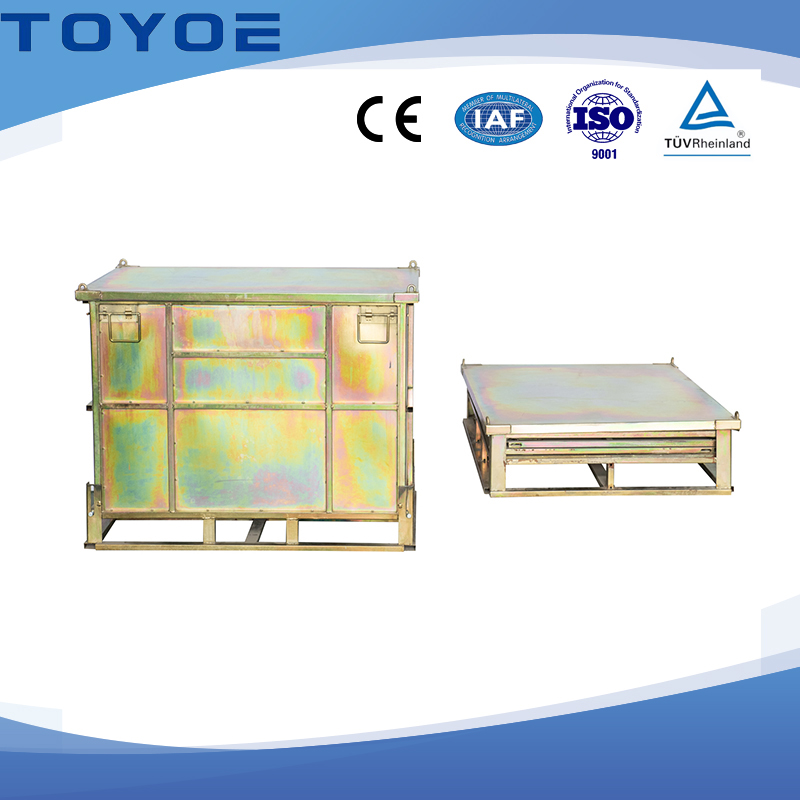
Selecting a heavily reinforced model serves as primary protection for high-value goods. Metal units shield products from sheer forces and direct impacts destroying plastic or wood alternatives. Heavy steel construction absorbs collisions from forklift counterweights and warehouse sweepers.
Relying on the container itself reduces waste and labor. Instead of wrapping a flimsy pallet in thick layers of shrink film, teams simply place goods inside a rigid structure and close the lid. The steel walls act as the ultimate barrier against external threats.
Advanced containers incorporate specific engineering choices to prevent handling damage. These built-in defenses reduce the margin for human error during rapid material movement.
Sometimes the structural container needs supplemental help, especially for irregular or highly fragile items. We use secondary consumable packaging to secure goods inside open-mesh or wire-sided units. Edge protectors prevent strapping from cutting into cardboard boxes or soft products. Heavy-duty PET strapping tightly binds smaller interior cartons together, preventing them from shifting within the larger enclosure.
Logistics teams must apply these consumables strategically. Use them only when the container's rigid walls cannot entirely immobilize the specific product geometry.
Preventing product migration inside a forklift pallet container requires specialized void fill. Empty space acts as the enemy of safe transit. Custom thermoformed trays hold complex automotive parts perfectly still. Corrugated partitions divide large internal spaces, keeping individual glass or machined metal components separated.
For heavier, less uniform items, engineers specify high-density foam inserts. These custom-cut blocks cradle the product, absorbing transit shocks before they reach sensitive electronics or calibrated machinery.
When securing loads onto a base pallet without solid walls, containment tactics become critical. Operations rely on two primary methods to anchor goods.
Forklift masts generate intense vibration, particularly when driving over uneven dock plates. Sensitive components require isolation from this kinetic energy. Anti-slip mats placed between the pallet base and the product prevent micro-shifting. Shock-absorbing base pads dampen the harsh vibrations traveling up through the forklift carriage.
Table 1: Load Stabilization Tactics Summary
| Protection Method | Ideal Application | Primary Benefit | Common Mistake |
|---|---|---|---|
| Thermoformed Trays | Identical, highly machined components | Exact fit prevents all internal movement | Using generic trays causing loose fits |
| PET Strapping | Heavy, settling loads (e.g., lumber, piping) | Maintains high retained tension over time | Under-tensioning during application |
| Anti-Slip Mats | Smooth, rigid goods on flat bases | Dampens forklift mast vibration | Placing on dirty or wet surfaces |
| 120-Gauge Stretch Wrap | Irregular profiles with sharp corners | High puncture resistance | Failing to anchor wrap to the pallet base |
Understanding manufacturer specifications prevents catastrophic overloading. Operations must differentiate clearly between static and dynamic capacities. Static capacity indicates the maximum weight a unit holds while resting motionless on the floor. Dynamic capacity represents the much lower, critical weight limit when a forklift actively moves the unit.
A reliable rule of thumb requires dynamic capacity to exceed your heaviest expected load by at least 20%. This buffer accounts for the intense multiplied forces generated by sudden forklift braking or rapid lowering speeds. Ignoring this buffer guarantees structural fatigue over time.
A strong container means nothing if it fails on the rack. You must validate base dimensions and runner designs against existing storage infrastructure. Pallet racks require specific runner spans to distribute weight safely across the load beams. Incorrectly sized bases cause point-loading failures, where the container punches through the wire decking or slips between beams.
Measure the distance between your rack's structural supports. Ensure the container's feet or runners sit firmly on load-bearing steel, rather than resting entirely on unsupported mesh.
Warehouse conditions fluctuate wildly. Assess environmental factors before finalizing specifications. If operations store containers outdoors, ultraviolet light quickly degrades standard plastics. Steel units require hot-dip galvanization to survive rain and snow without rusting. Facilities using corrosive chemicals or frequent high-pressure wash-downs need specialized powder coating to prevent rapid oxidation.
Never rely on theoretical engineering limits or marketing claims. Demand concrete, verifiable load-testing data. Reputable manufacturers provide ISO certifications and results from third-party drop and compression tests. These documents prove the equipment withstands real-world abuse.
Ask for video evidence of failure-point testing. Seeing exactly how a unit bends or breaks under extreme stress helps you understand its safety margins. Avoid vendors failing to produce documented testing histories.
Standard boxes rarely fit complex industrial needs perfectly. Assess whether the manufacturer engineers custom internal packaging tailored to your specific product geometries. Can they integrate hanging textile dunnage for delicate painted car parts? Can they weld custom divider slots?
A supplier doubling as a packaging engineer saves you the hassle of coordinating between a container builder and a separate dunnage provider. Integrated design ensures the interior protection matches the exterior dimensions flawlessly.
Testing a small batch in your actual operational environment reveals flaws blueprints hide. Run a pilot program before authorizing a full fleet deployment. Send the test units through your roughest transit loops. Let your fastest forklift operators handle them. Monitor how LTL carriers treat them.
Simultaneously, scrutinize the warranty. Strong warranties cover weld failures and structural buckling under normal dynamic loads. Reject contracts filled with loopholes blaming every failure on "operator error."
Moving from evaluation to full implementation requires treating protection as a cohesive system rather than a single purchase. True load security combines structurally sound metal enclosures, precise internal void fill, and rigorous adherence to dynamic load ratings. When these elements align, product damage plummets and dock safety improves dramatically.
Protecting your freight demands active management. Stop treating torn stretch wrap and dented sidewalls as the unavoidable cost of doing business. Upgrade your primary defense structures to eliminate the root cause of the impacts.
Your immediate next step involves auditing your current LTL freight damage reports. Identify exactly which products suffer the highest rejection rates. Trace those failures back to their packaging origins to determine whether you need better internal dunnage or an entirely upgraded exterior structural defense.
A: Static capacity measures the maximum weight a container safely holds when sitting completely stationary on the ground, often stacked. Dynamic capacity is the significantly lower maximum weight limit allowed when a forklift actively lifts, moves, or lowers the container. Dynamic limits account for the intense kinetic forces of motion and braking.
A: Yes. For rigid or self-contained items, rigid metal walls entirely eliminate the need for external shrink wrap and plastic banding. The container itself secures the load. However, you may still need internal void fill like foam inserts to prevent fragile goods from bouncing against the hard metal interiors.
A: Forklift pockets are enclosed steel channels welded to the base. They force the operator to insert the steel tines perfectly straight. This guided entry prevents operators from skewing the forks upwards, stopping them from accidentally puncturing the container's sidewalls or destroying the products resting inside.
A: NMFTA guidelines mandate that all palletized loads must be properly secured to the base and protected against shifting during transit. LTL carriers strictly enforce these rules. If they deem a container loose or improperly banded, they will reject the freight to avoid liability for potential damage during transit.

