
Views: 0 Author: Site Editor Publish Time: 2026-09-06 Origin: Site
Poor container specifications often carry heavy, hidden costs. Mismatched dimensions regularly waste valuable truck space during transit. Under-specced load capacities quickly cause dangerous structural failures on the warehouse floor. Moving away from expendable packaging demands precise planning. Transitioning to reusable bins requires aligning your upfront capital against long-term operational savings. You cannot afford to guess on payload limits or footprint compatibility. We designed this guide to provide a clear, pragmatic framework for your next project. Procurement and logistics managers will learn how to evaluate dimensions accurately. We will outline essential payload thresholds and critical material requirements. You can use this data to confidently structure your next RFQ.
Logistics managers must separate load capacities into two distinct categories. You have static loads and dynamic loads. A static load defines the maximum weight a container supports when resting. This occurs when units sit stacked in a warehouse. A dynamic load defines the weight a container safely holds while moving. Forklifts, trucks, and rail cars apply sudden kinetic stress. Dynamic ratings always sit much lower than static ratings. You must design your system around dynamic limits to prevent transit failures.
Handling these operational stresses requires choosing the correct metal class. This term refers to the exact gauge of steel wire or sheet metal used. Thinner steel gauges bow outward under heavy pressure. Weak welds fracture during rough forklift handling. Heavy-duty applications demand thicker wire mesh and reinforced tubular steel bases. Specifying the proper steel grade prevents catastrophic structural bowing. It also ensures safe stacking over long storage periods.
You must map your specific product weights to standard container capabilities. Overloading a light-duty unit creates severe safety hazards. Underloading a heavy-duty unit wastes valuable capital. We use standard tiers to categorize baseline capacities.
Standard Capacity Decision Matrix
| Capacity Tier | Weight Limit | Ideal Application | Operational Risks of Overloading |
|---|---|---|---|
| Light-Duty | Under 500kg | Small plastic parts, textiles, light consumer goods | Base deflection, wire mesh bowing, hinge failure |
| Medium-Duty | 500kg - 1000kg | Machined components, heavy retail goods, hardware | Weld fractures at drop-gate corners, stacking instability |
| Heavy-Duty | Over 1000kg | Castings, dense automotive parts, metal stampings | Forklift tine puncture, total structural collapse during transit |
Evaluating exact dimensions prevents costly supply chain bottlenecks. You must measure both internal and external dimensions separately. Internal dimensions dictate your true usable volume. External dimensions define the physical footprint on the floor. Wall thickness and folding mechanisms consume valuable space. You need accurate numbers for both to optimize your daily material flow.
Warehouse integration relies heavily on these specific measurements. You must match your external footprint to standard pallet bases. Most facilities use Euro pallets (1200x800mm) or US standard bases (48x45 inches). Aligning foldable metal container specifications to these norms ensures racking compatibility. It also maximizes trailer cube optimization. Every inch of empty trailer space burns shipping budget. A perfectly sized footprint fills a standard 53-foot trailer without leaving useless voids.
You must also calculate the return ratio of your units. Industry experts often call this the collapsibility ratio. This metric defines how small the unit becomes when empty. A standard 3:1 ratio means three collapsed units occupy the exact vertical space of one assembled unit. Some highly optimized designs achieve a 4:1 ratio. Collapsing units to one-third or one-quarter of their height dramatically improves reverse logistics math. You ship far less empty air back to your suppliers.
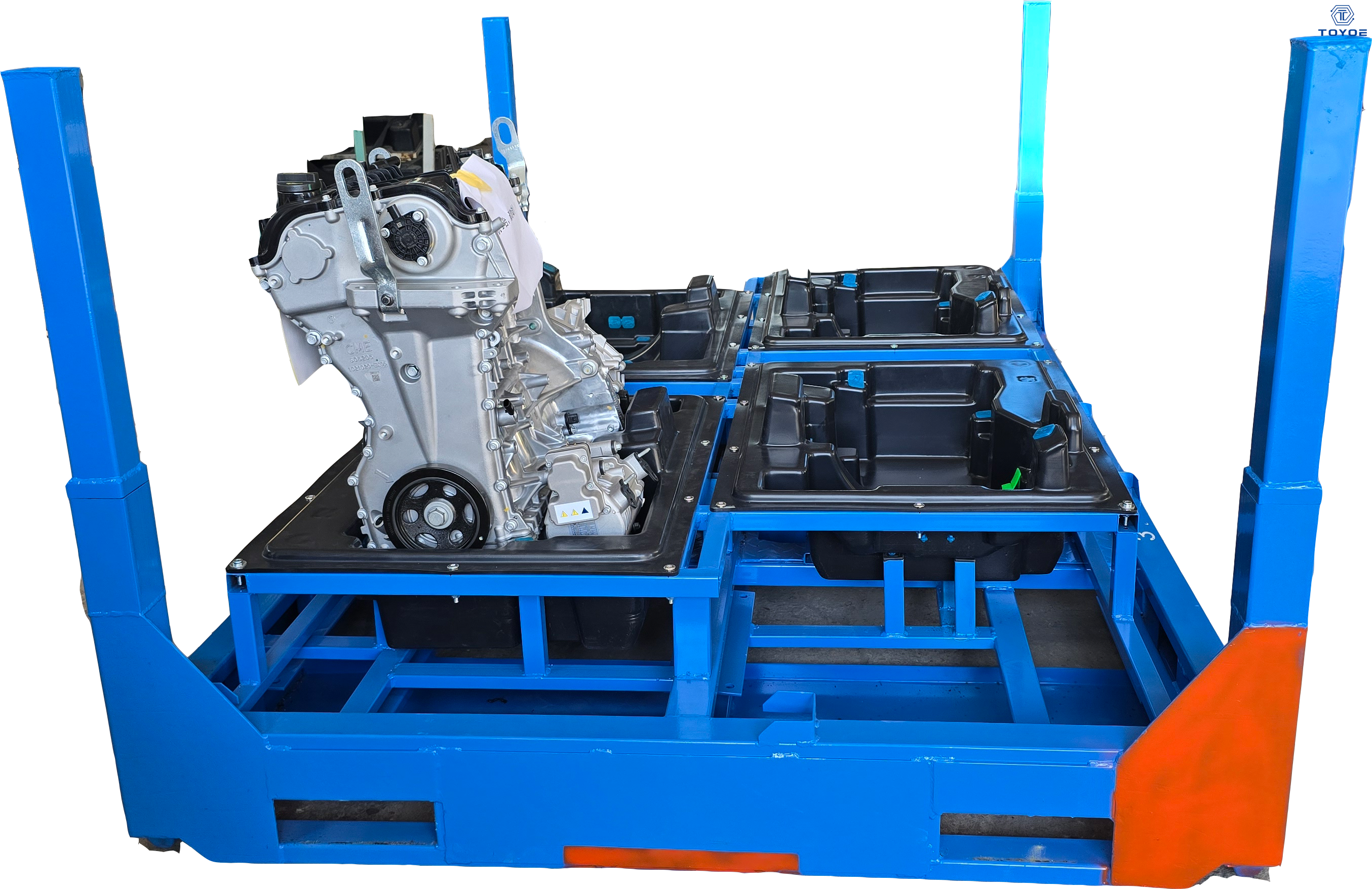
Tier-1 automotive logistics introduce unique and complex hurdles. Car engines and transmissions are heavy, asymmetrical, and highly valuable. Standard wire baskets fail completely in these environments. An engine block distributes weight unevenly. It features fragile sensors on one side and dense cast iron on the other. You cannot simply toss these parts into a standard square bin.
Engineers solve this by designing a custom foldable metal rack for automotive motor transit. This equipment differs significantly from a basic storage basket. Manufacturers add heavily reinforced steel bases to handle asymmetric weight distribution. They install customized polyurethane dunnage to cradle the engine safely. Specialized locking pins prevent the motor from shifting during transit. The outer frame still folds flat for return shipping, but the interior holds the part motionless.
Implementation requires facing a practical reality. Custom engineering demands a higher upfront investment. Designing CAD models and producing custom dunnage takes time. However, this investment eliminates product damage entirely. It also resolves frustrating line-side handling inefficiencies. Assembly workers can access the engine easily without removing secondary packaging. This speeds up production rates significantly.
Logistics planners frequently debate between rigid bins and collapsible alternatives. You must objectively compare fixed-wall metal units against folding models. Each option serves a distinct operational purpose. Choosing incorrectly wastes budget or complicates maintenance.
Fixed-wall bins work best for purely static, long-term warehouse storage. They have no moving parts. They offer maximum rigidity for stacking heavy loads safely. Conversely, a foldable metal container excels in closed-loop supply chains. These units thrive where return freight costs run high. They collapse rapidly to save massive space on empty return legs. If your bins never leave the factory floor, foldability offers little value. If they travel hundreds of miles weekly, foldability becomes mandatory.
You must transparently discuss the maintenance aspect before purchasing. Moving parts naturally wear down over time. Collapsible hinges require occasional lubrication. Drop-gates require regular visual inspection. Operators can accidentally bend locking latches with forklifts. Fixed-wall bins do not face these specific mechanical issues. You trade slightly higher maintenance routines for massive return shipping savings.
Comparison Chart: Fixed-Wall vs. Foldable Solutions
| Comparison Metric | Fixed-Wall Metal Containers | Foldable Metal Containers |
|---|---|---|
| Return Freight Efficiency | Very Low (Ships empty air) | Very High (3:1 or 4:1 ratio) |
| Maintenance Needs | Minimal (No moving parts) | Moderate (Hinges, latches, drop-gates) |
| Ideal Supply Chain | Static warehouse storage | High-volume closed-loop transit |
| Upfront Procurement Cost | Generally lower | Slightly higher (Engineering complexity) |
Selecting the right manufacturing partner mitigates risk. You need strict criteria for shortlisting candidates. Do not select a vendor based solely on the lowest unit price. Poor welding or inferior steel will quickly destroy your operational savings. Use a stringent vetting process.
Prototyping remains absolutely vital. A credible foldable metal container supplier will insist on a sample run. They want you to test line-side ergonomics before mass production begins. You must verify transit durability by running the prototype through your actual shipping lanes. Real-world testing exposes flaws that blueprints hide.
Look closely at compliance and quality assurance indicators. You want verifiable proof of excellence.
Size and capacity represent much more than basic procurement checkboxes. They serve as the determining factors of supply chain efficiency and workplace safety. Choosing standard or custom specifications dictates how smoothly your materials flow. It directly impacts your bottom line.
Do not leave your next packaging rollout to chance. Contact a packaging engineering specialist today. Request a custom specification sheet or a CAD prototype designed exclusively for your unique application.
A: Usually 5-10 years depending on the metal class, usage environment, and adherence to safe handling protocols. Avoiding forklift abuse significantly extends this lifespan. Regular inspection of moving parts ensures maximum longevity.
A: Yes, standard specifications usually allow stacking 3 to 4 high when fully loaded. However, this requires strict adherence to the manufacturer's static weight limits. You must also place them on a level concrete floor.
A: Upfront unit costs are higher due to engineering and tooling. However, custom dimensions often yield a higher ROI by maximizing truck space. They also eliminate the need for costly secondary packaging.
A: Most standard designs offer a 3:1 to 4:1 ratio. This means 3 to 4 collapsed containers occupy the same vertical footprint as one fully assembled unit. This saves substantial space on return freight.

