
Views: 0 Author: Site Editor Publish Time: 2026-07-30 Origin: Site
In industrial logistics, over-speccing equipment wastes critical capital. Conversely, under-speccing leads to catastrophic product damage and severe supply chain bottlenecks. Procurement teams often obsess over unit price rather than actual operational tolerances. They frequently ignore how crucial variables like dynamic load capacity and forklift entry design impact long-term profitability. A purely data-driven approach requires looking past polished marketing claims. You must align technical parameters directly against specific warehouse constraints and transit realities. This comprehensive guide details exactly which technical specifications genuinely matter for modern supply chains. You will learn how to decode complex load limits accurately. We also explain how to choose the right materials for harsh operational environments. Finally, you will discover proven strategies to verify supplier claims before committing to a massive fleet upgrade. Relying on precision over guesswork protects your operational bottom line.
Every technical feature on a bulk container translates directly into operational outcomes. Smart procurement maps these parameters against tangible cost savings. For example, a minor tare weight reduction saves thousands of gallons of diesel fuel over a year of regional transit. Interlocking bases prevent stack collapses. This specific structural feature reduces workplace accidents and protects fragile inventory. You must view these containers as active logistical assets.
Ignoring technical parameters carries severe consequences. A collapsed load in transit destroys valuable merchandise instantly. It also triggers delayed delivery penalties. Furthermore, inadequate hygiene standards lead to rejected food shipments due to contamination risks. Rapid fleet degradation occurs when buyers select sub-optimal plastics for freezing environments. These failures drain budgets far faster than initial purchasing premiums.
Standard off-the-shelf units suit many basic distribution networks. However, standard dimensions sometimes create dead space in specialized transport vehicles. In these scenarios, investing in a custom heavy duty pallet box yields a dramatically better long-term return on investment. Custom units fit bespoke OEM parts perfectly. They eliminate transport vibration and maximize every square inch of trailer volume. Establish clear baseline criteria to decide whether your workflow demands standard models or tailored engineering.
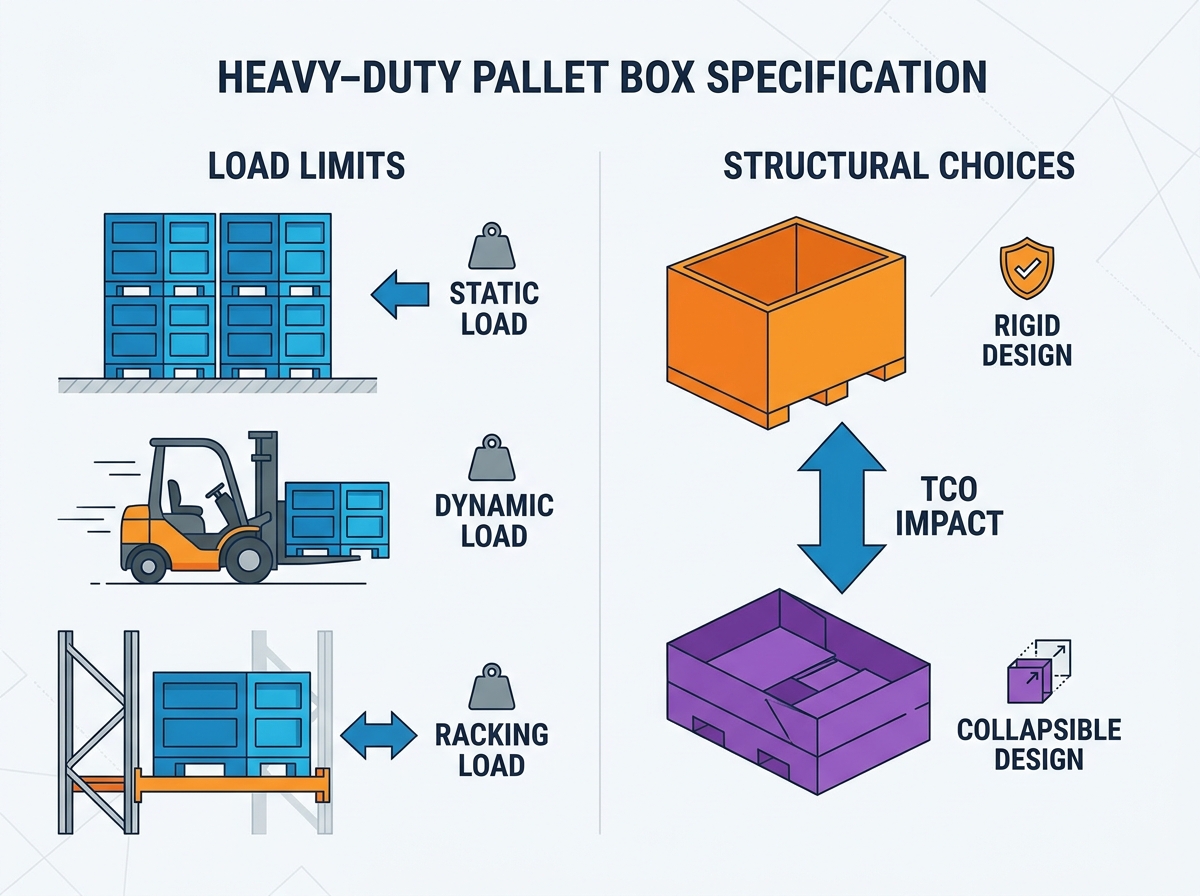
Load limits are highly contextual metrics. Misunderstanding them guarantees structural failure. Static load refers to the maximum weight a bottom container can bear while resting on a solid, flat concrete floor. Warehouses often stack these units high to save space. Testing protocols typically assume evenly distributed payloads. Point loads, however, concentrate stress in small areas. You must adjust your calculations if you ship dense, irregularly shaped machinery parts.
Transit conditions introduce entirely different physical forces. Dynamic load ratings dictate what the container can handle during forklift movement and truck transportation. This weight rating drops significantly compared to static limits. Forklifts bounce over expansion joints. Trucks hit highway potholes. These actions multiply kinetic energy against the plastic walls. Real-world truckers frequently complain about center-of-gravity shifts. An overloaded container swaying in a trailer risks catastrophic sidewall blowouts.
Racking load specifications test absolute structural limits. Placing units on edge racks removes center support entirely. The entire payload weight presses down on the outer perimeter rim. If the base sags, the unit can slip through the rack. This scenario causes massive safety hazards. Always verify if the container features reinforced steel runners for high-bay racking systems.
Never accept internal marketing figures at face value. Instruct your buyers to request independent load test certificates. Reviewing documented heavy duty pallet box specifications ensures the product meets stringent ISO or ASTM safety standards. Independent laboratory data provides a reliable baseline for safe warehouse operations.
Polymer selection determines how well a container survives harsh conditions. High-Density Polyethylene (HDPE) delivers exceptional impact resistance. It performs brilliantly in cold storage because freezing temperatures do not make it brittle. Conversely, Polypropylene (PP) offers greater stiffness and superior heat resistance. PP works exceptionally well in high-temperature industrial washing facilities. Understanding this chemical distinction prevents premature fleet breakage.
Table 1: Polymer Comparison for Bulk Containers
| Material Type | Primary Strengths | Best Use Cases | Limitations |
|---|---|---|---|
| High-Density Polyethylene (HDPE) | High impact resistance, cold tolerance | Cold chain, agriculture, freezing storage | Lower stiffness under extreme heat |
| Polypropylene (PP) | High stiffness, excellent heat resistance | Automotive, high-temp washing loops | Can become brittle in deep freeze |
Rigid construction provides maximum durability. Manufacturers create single-piece injection-molded or structural foam boxes for extreme environments. These solid units lack moving parts. They dominate harsh, closed-loop supply chains where rough forklift handling is common. Every premium heavy duty pallet box built for heavy manufacturing relies on unbroken structural continuity.
Collapsible designs solve return freight inefficiencies. A standard 3:1 fold-ratio means three empty folded units fit into the space of one fully assembled unit. This geometry saves immense fuel costs on return trips. However, hinges and latches introduce mechanical weak points. You must evaluate cycle-life durability carefully. Dirt and debris can jam folding mechanisms. Regular maintenance and careful handling extend their useful lifespan considerably.
Wall design also dictates functionality. Solid walls retain liquids and prevent cross-contamination. Meat processing and chemical industries demand unbroken surfaces. Vented walls allow crucial airflow. Agriculture relies on venting to regulate temperature and prevent rapid crop rot during transit. Match the wall architecture directly to your cargo requirements.
Exterior footprint dimensions govern transport optimization. Standard sizes like 1200x1000mm (European) or 48x45 inches (North American automotive) cube out standard trailers perfectly. Fractional mismatches create dangerous dead space. Unsecured cargo shifts during transit, causing damage. You must measure your fleet capacities meticulously. Integrating a well-sized industrial logistics heavy duty pallet box eliminates wasted air and stabilizes the entire payload.
Loading height standards require careful balance. Buyers must factor in usable internal volume versus the external vertical profile. Taller walls hold more volume but might exceed safe forklift visibility limits. Furthermore, exceeding standard trailer clearance heights causes immediate logistical failures. Always account for stacking configurations when calculating maximum transport heights.
Regulatory compliance dictates material sourcing heavily. Food and pharmaceutical supply chains require FDA or USDA approved virgin resins. These materials prevent chemical leaching into consumables. Shipping hazardous materials requires strict UN certification. Non-compliant packaging invites severe legal penalties and compromises public safety.
Cleanability impacts operational turnaround times. High-volume hygiene environments utilize automated high-pressure washing systems. Containers must feature smooth internal walls. Rounded corners prevent bacterial buildup in tight crevices. Strategically placed drainage holes allow water to escape quickly. If water pools inside, the drying process stalls, causing mold growth.
Modern warehouses run on digital intelligence. Physical assets must integrate seamlessly into digital Warehouse Management Systems (WMS). Look for containers featuring designated, recessed zones for RFID tags and barcode labels. Recessing these tags protects them from scraping against forklift tines. Advanced IoT tracking modules monitor location, ambient temperature, and shock events in real-time. This traceability provides absolute visibility across complex supply chains.
Supplier transparency separates reliable partners from mere brokers. Assess their exact manufacturing methods. High-pressure injection molding delivers exceptional precision and tighter tolerances. Rotational molding works well for massive custom sizes but often yields wider wall thickness variations. Quality control tolerances must align with your automation equipment. Automated retrieval systems jam if container dimensions vary by even a few millimeters.
Investigate realistic warranty terms and lifecycle support. What is the actual replacement cycle for their products? Reliable manufacturers stand behind their engineering. Look for companies offering buy-back or recycling programs for broken units. These programs reduce landfill waste and recover minor capital from damaged assets. Choosing an accountable heavy duty pallet box supplier guarantees ongoing operational support.
Never commit to a fleet-wide purchase blindly. Implement a strict pilot program protocol first.
Selecting the right bulk container is a precise engineering decision, not a simple purchasing commodity exercise. Ignoring structural nuances introduces immense risk into your daily operations. Proper material selection, accurate load ratings, and optimal footprint dimensions protect your inventory. They also safeguard your workforce and streamline transit logistics across your entire network.
Audit your current breakage rates immediately. Measure your exact supply chain constraints, including specific rack types, truck dimensions, and chemical hygiene needs. Draft a highly strict specification sheet detailing these requirements. Present this document to vetted manufacturers before requesting any official supplier quotes. Proactive engineering ensures long-lasting, highly efficient warehouse operations.
A: The lifespan varies significantly, typically ranging from five to ten years. Cycle frequency, direct UV exposure, and operational abuse dictate actual longevity. Unlike traditional wood alternatives that splinter and rot quickly, premium plastic polymers resist moisture and impacts, offering a vastly superior operational lifespan.
A: Single-piece rigid boxes are rarely repairable safely. Welding cracked plastic compromises overall load-bearing integrity. Conversely, premium collapsible boxes feature modular construction. You can easily replace damaged side panels or latches without discarding the entire base, significantly extending the unit's lifecycle.
A: Consider custom engineering when standard dimensions create dead space in your specific transport vehicles. Custom units are ideal for housing specialized OEM parts safely. They also allow for integrated custom dunnage and targeted weight reinforcements necessary for uniquely dense or fragile payloads.
A: Freezing temperatures increase brittleness in certain standard plastics. A minor impact can shatter a cold, low-quality bin instantly. Cold-chain logistics require specific High-Density Polyethylene (HDPE) blends. These specialized polymers maintain crucial structural flexibility and impact resistance even in deep-freeze environments.

