
Views: 0 Author: Site Editor Publish Time: 2026-08-26 Origin: Site
Supply chain managers face a continuous procurement dilemma. You must balance the immediate availability and lower upfront cost of off-the-shelf containers against the long-term operational efficiency of customized units. Standard bins often seem cheaper initially. Yet, logistics directors must secure strict budget approvals to justify custom tooling. Building a defensible business case requires clear financial evaluation and operational foresight. Without this objective analysis, companies risk overspending on standard solutions holding hidden operational penalties.
This article provides an objective, engineering-focused framework to guide your packaging decisions. We will show you exactly when customization yields a positive return on investment. You will learn when standard options truly suffice and when structural modifications become necessary to keep your logistics running smoothly.
Evaluating a standard reusable pallet box against a custom model begins with understanding your baseline operational requirements. Not every supply chain needs a highly engineered container. You must recognize when a generic footprint serves your goals.
Off-the-shelf products work best in predictable, low-variance environments. Standard GMA pallet footprints (typically 48 x 40 inches in North America) easily integrate into conventional warehouse racking. You should rely on standard units for generic supply chains handling uniformly sized packaged goods. Low-volume pilot programs also benefit from standard boxes. If you face sudden seasonal spikes and need fast deployment, purchasing stock inventory prevents severe fulfillment delays.
Forcing a standard box into a specialized workflow introduces hidden costs. Operational failures often indicate standard equipment is underperforming. Procurement teams frequently buy excessive internal dunnage, such as single-use corrugated cardboard, to fill empty voids. You might experience repeated load-shift damage because parts do not sit securely inside a generic cavity. Furthermore, standard boxes might fail to maximize truckload cube utilization. If a standard footprint leaves empty air at the top or sides of a shipping trailer, you pay for inefficient transportation every single trip.
Buyers often mistakenly assume "custom" requires a ground-up new mold costing hundreds of thousands of dollars. Customization exists on a broad spectrum. You can apply minor modifications to standard molds to achieve specific goals without excessive capital expenditure.
Here is a breakdown of the typical modification spectrum:
| Modification Level | Examples | Typical Cost & Lead Time | Best Used For |
|---|---|---|---|
| Low (Post-Mold) | Hot stamping, RFID integration, custom labeling, barcode placards. | Low cost, 1-3 weeks. | Asset tracking and basic brand identification. |
| Medium (Cut-and-Weld) | Height reduction, custom drop door installations, added drainage holes. | Moderate cost, 4-8 weeks. | Ergonomic access and specific volumetric restrictions. |
| High (Full Custom Mold) | Unique external dimensions, reinforced steel bases, specialized polymer blends. | High cost, 12-24 weeks. | Automated systems integration and extreme payload geometry. |
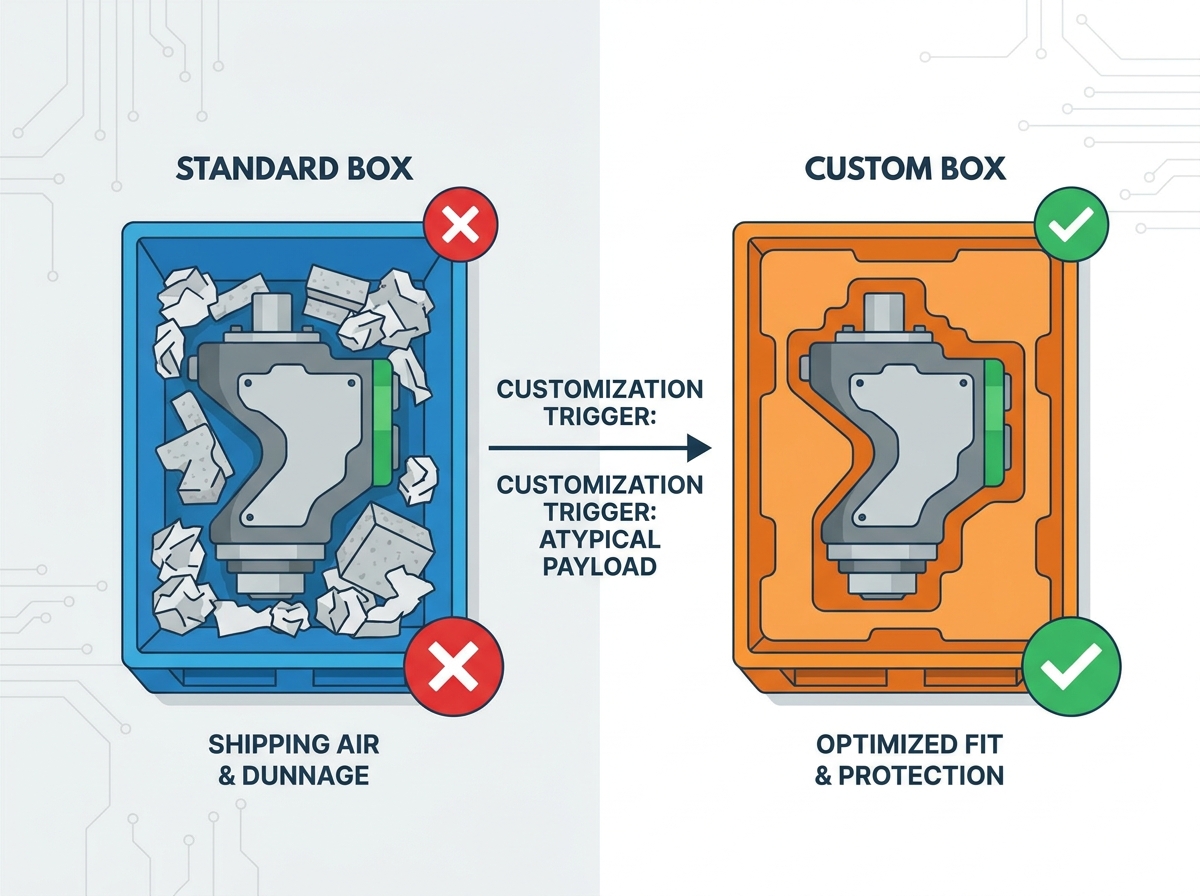
Upgrading logistics packaging requires definitive triggers. You should consider structural modifications when facing these four specific operational challenges, which often demand a custom reusable pallet box to eliminate persistent bottlenecks.
Non-standard part sizes frequently lead to shipping air. Think of long, curved automotive bumpers or irregularly shaped heavy machinery components. Placing these items inside a standard square or rectangular box leaves massive internal voids. This poor geometry forces warehouse staff to rely heavily on disposable packaging to prevent movement.
A custom solution addresses this directly. You can specify internal molded inserts or customized box dimensions that closely hug the product. This eliminates single-use corrugated dunnage entirely. Protecting fragile components with custom foam or thermoformed inserts built directly into the container walls reduces scrap rates significantly.
Standard plastic containers carry specific dynamic and static load limits. When moving dense materials like metal forgings, raw rubber, or industrial batteries, standard bases will buckle or bow. Material deflection causes catastrophic failures during forklift transport or warehouse stacking.
You can evaluate structural customization to solve this. Adding encapsulated steel reinforcements within the plastic base dramatically increases rigidity. Engineers can modify ribbing structures underneath the container to distribute extreme point loads. Additionally, you can specify a unique polymer blend, opting for high-impact virgin High-Density Polyethylene (HDPE) tailored for extreme temperature resistance and impact durability.
Manual handling limitations on the factory floor create severe productivity drags. Workers assembling parts line-side cannot safely reach over high sidewalls to extract heavy components at the bottom of a container. Ignoring ergonomics leads to workplace injuries and slower takt times.
Customization transforms the container into a highly accessible tool. You can request custom drop-door placements on adjacent sides for easier access. Modifying the height profiles allows the box to fit perfectly under specific conveyor lines or assembly workstations. For agricultural workflows, you can mandate specific drainage holes or ventilation slots to prevent moisture buildup and product spoilage.
Managing large fleets of returnable assets requires visual and digital tracking. Standard grey or black boxes offer zero visual management. If you process food materials, using the same colored bins for allergens and non-allergens poses a severe safety risk.
Custom colors enable strict visual zoning. You can designate red boxes exclusively for hazardous materials or raw meats, and blue boxes for finished, clean goods. Structurally, you can request custom pockets molded into the walls to house permanent IoT or RFID tracking tags. These recessed accommodations protect sensitive tracking hardware from impact shears, preventing tag loss in transit.
Integrating modern packaging with robotics leaves no room for error. When setting your reusable pallet box specifications, you must heavily scrutinize dimensional stability.
Automated storage and retrieval systems (AS/RS) rely on exact geometries to move inventory at high speeds. Automated conveyor rollers and robotic shuttle carts cannot tolerate standard plastic deflection under heavy loads. If a generic box bows downward by just half an inch in the center, it will snag on conveyor transitions or trigger system-wide safety shutdowns. Custom tooling allows engineers to reinforce the base specifically for the span of your automated racking.
Robotic routing relies on optical sensors and photo-eyes. Custom bases play a critical role in preventing jams and ensuring accurate automated routing. A specialized runner configuration ensures smooth transitions across multidirectional conveyor belts. You might also need specific optical contrast colors. If your conveyor belts are black, a standard black container might fail to register on basic optical sensors, requiring a custom bright-colored base for reliable detection.
Tolerance stacking occurs when multiple small dimensional variations combine to create a significant alignment error. Robotic palletizers expect every container to measure exactly to the millimeter. If standard boxes expand or warp, the robotic arm will misalign the stack, causing structural collapse. You face a strict engineering necessity for precise, customized dimensional tolerances when integrating with robotic decanting machinery. Custom molds guarantee identical replication, ensuring high-speed robots never crush or drop a payload.
Calculating the financial viability of custom containers requires an exact mathematical approach. You must look beyond the initial purchase order and evaluate the long-term impact on your freight and labor lines.
A ground-up custom design demands steel mold creation. This involves upfront design fees, prototyping, and heavy machining costs. You must frame these not as sunk expenses, but as amortized capital investments. A robust mold typically produces hundreds of thousands of units over its lifespan. When distributed across a five-to-seven-year operational window, the per-unit premium diminishes rapidly compared to the daily savings.
Determining your break-even horizon requires precise data inputs. You calculate this by stacking your monthly operational savings against the initial capital outlay.
Follow these standard steps to build your model:
Analysis Variables Summary
| Cost Reduction Variables (Savings) | Capital Expenditure Variables (Costs) |
|---|---|
| Eliminated single-use dunnage purchases | Initial CAD design and engineering fees |
| Increased truckload density (Freight savings) | Physical 3D prototyping and testing |
| Reduced product damage and scrap rates | Steel mold manufacturing cost |
| Labor time saved handling waste materials | Per-unit material production cost |
Customized units prove mathematically superior in tightly controlled networks. When you invest in a closed-loop logistics reusable pallet box, your assets travel exclusively between your manufacturing plant and your dedicated suppliers or distribution centers. In this environment, container loss and theft remain near zero. High retention rates ensure every custom box survives long enough to cross the break-even threshold and generate pure operational profit.
A custom packaging project carries inherent rollout risks. Selecting the right reusable pallet box supplier dictates the success or failure of your entire investment.
You must verify if a supplier relies on outsourced design firms or maintains in-house engineering teams. In-house CAD and 3D prototyping capabilities are crucial. Before anyone cuts a steel mold, you need physical, scaled-down prototypes to fit-test your exact payloads. A supplier lacking prototyping capabilities forces you to gamble on digital drawings alone, increasing the risk of expensive rework later.
Discuss the legal and commercial risks early. You need absolute clarity on who owns the custom mold once it is paid for in full. If your supplier undergoes financial distress or you decide to shift production closer to a new facility, you must legally possess the right to extract that mold. Ensure intellectual property contracts state clearly that your specific dimensional designs remain proprietary to your organization.
Never assume all plastics behave the same. You must ensure the supplier provides data-backed material specifications. Ask for the exact ratios of virgin versus recycled HDPE or Polypropylene (PP). If your containers operate in freezing environments or under extreme UV exposure, the supplier must prove their polymer blends contain the correct impact modifiers and UV stabilizers to prevent premature cracking.
Avoid suppliers who simply hand over a generic price sheet when you ask for customization. Advise your procurement team to request a comprehensive financial evaluation and ROI consultation. A capable manufacturing partner will actively audit your freight density and workflow before recommending a structural modification.
Modifying logistics packaging is never about aesthetic preference. It remains a strategic method to solve specific mathematical inefficiencies in logistics and handling. Standard containers work well for predictable, low-stress environments. However, when you face dense loads, strict automated integration, or high cube loss, custom tooling quickly pays for itself.
Your next step requires active measurement. Conduct a strict cube utilization and dunnage audit of your current standard bins. Document exactly how much empty air you ship and how much cardboard you discard monthly. Armed with this operational data, you can confidently approach a supplier to request a precise structural quote and prototype.
A: A fully custom project typically takes 12 to 24 weeks. This timeline includes initial CAD design approvals, physical 3D prototyping, testing, steel mold cutting, and the final production runs. Minor modifications like cut-and-weld resizing take significantly less time, usually completed in 4 to 8 weeks.
A: Yes. Full custom molds usually require high MOQs (often thousands of units) to justify the extensive tooling investments. Conversely, minor post-mold modifications like custom labeling or retrofitted drop doors have much lower thresholds, sometimes starting at just a few hundred units.
A: Absolutely. You can utilize post-mold modification techniques. Engineers can cut and weld standard bins to alter their height, install custom access doors, add specific drainage holes, or integrate RFID tags. These methods bypass heavy tooling costs entirely.
A: Custom reusable designs drastically reduce single-use cardboard waste in your supply chain. Life-cycle assessments show that despite the energy used in manufacturing, durable custom plastic units offset their carbon footprint quickly. Furthermore, rigid plastic containers remain 100% recyclable at the end of their 5-to-10-year service life.

