
Views: 0 Author: Site Editor Publish Time: 2026-08-08 Origin: Site
In fresh produce logistics, the wrong container choice directly correlates with retail rejection rates. Produce suffers primarily through poor temperature management, physical bruising, and inefficient reverse logistics. Upgrading to a reusable packaging model requires aligning specific container geometries with your crop's respiration rates. You must also account for harsh cold-chain realities. Agricultural operations cannot afford packaging failures during peak harvest. Supply chains demand robust, predictable performance from every asset.
This guide breaks down how to evaluate and shortlist a collapsible plastic pallet box based on structural design, hygiene compliance, and supply chain compatibility. We will explore key metrics like cooling efficiency, foldability, and material selection. You will learn exactly how to balance physical protection against reverse logistics efficiency. Our analysis provides actionable frameworks to optimize your fresh produce handling.
Fresh fruits and vegetables continue to respire after harvest. They consume oxygen and release ethylene gas. They also generate significant internal heat. Improper box design traps these harmful byproducts. This trapped heat accelerates cellular degradation rapidly. Spoilage rates climb when ventilation fails to match crop respiration. High-respiration crops require immediate and sustained heat removal. A poorly designed container acts like an oven. It creates a micro-climate fatal to fresh produce shelf life.
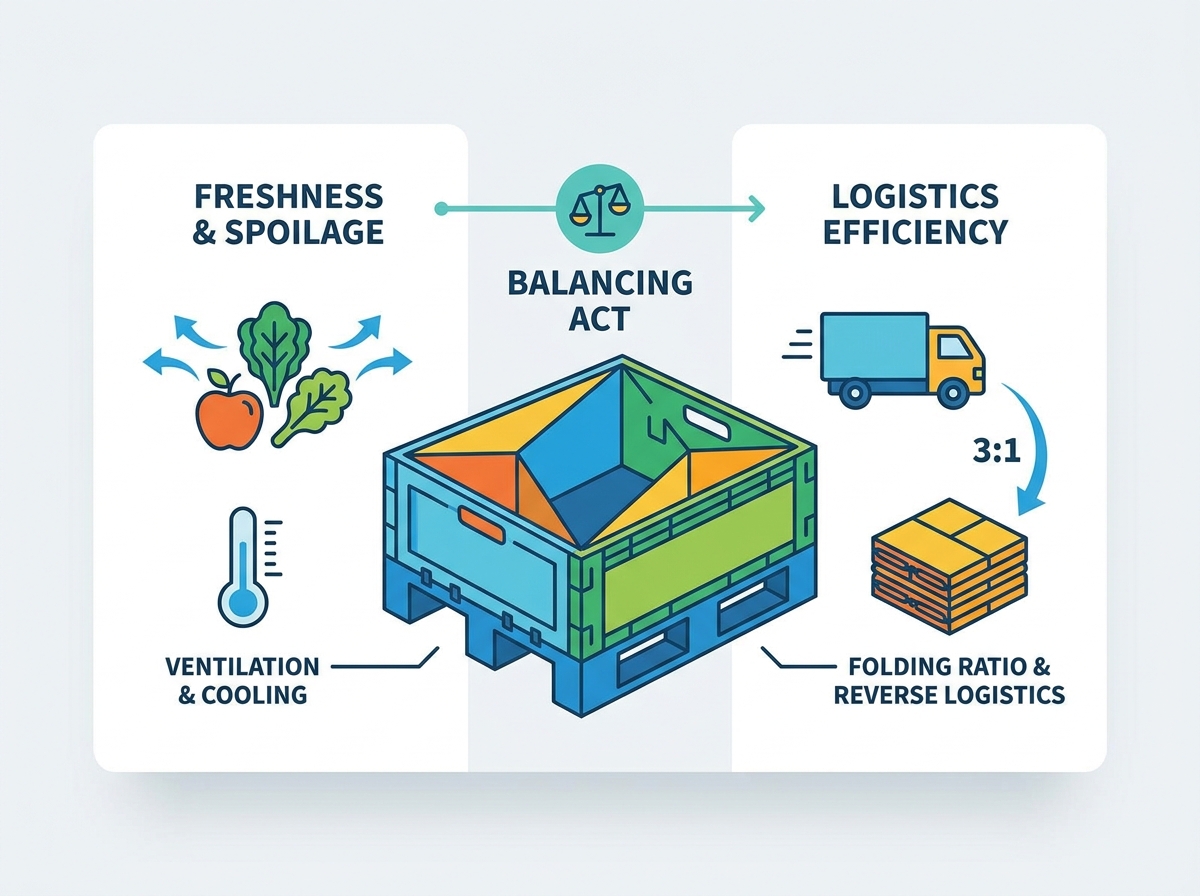
You face a difficult operational balancing act. Rigid walls prevent tractor-transit vibration damage. Farm roads subject loads to severe mechanical stress. However, you also need a high folding ratio. Excellent foldability minimizes empty-leg freight costs during return trips. A poorly engineered fresh produce collapsible plastic pallet box might fold flat easily. Yet, it could crack under dynamic transit loads. Achieving both structural integrity and collapsibility remains the ultimate engineering challenge.
We must establish clear benchmarks for procurement. A successful container deployment will meet specific operational objectives. You should evaluate every design against these core functions.
Design variations directly impact crop preservation. You must match the wall structure to your specific agricultural product. Different crops demand entirely different handling environments.
Fully vented designs serve high-respiration crops best. Examples include apples, citrus, onions, and potatoes. Manufacturers engineer optimized slot patterns into the walls. These slots allow uniform airflow across the entire load. They enable highly efficient hydro-cooling and forced-air cooling. The vents draw heat out of the center of the mass rapidly. Rapid temperature reduction extends retail shelf life significantly. However, excessive venting can compromise overall wall strength. Engineers must calculate the precise void-to-solid plastic ratio.
Solid wall designs solve completely different logistical problems. Some produce requires high water retention during transport. Highly delicate small items benefit from smooth, unbroken surfaces. Cherries and small berries can catch in large ventilation slots. Furthermore, post-harvest processing often involves washing or soaking. Solid walls excel in these aquatic applications. They safely contain liquids and protect against external contaminants. However, they completely lack airflow capabilities. This makes them incompatible with standard field-cooling methods.
Many operations adopt a practical hybrid approach. They specify a solid base alongside vented sides. The solid base retains localized moisture at the bottom. Meanwhile, the vented sides allow essential lateral airflow. This hybrid approach prevents delicate bottom layers from drying out. It still permits effective forced-air cooling through the pallet stack.
Wall Design Comparison Chart
| Design Type | Ideal Produce Applications | Cooling Method Compatibility | Moisture Retention Level |
|---|---|---|---|
| Fully Vented | Apples, Citrus, Onions, Potatoes | High (Forced-air, Hydro-cooling) | Low |
| Solid Wall | Berries, Processed Foods, Liquids | Low (Ambient or surface only) | High |
| Hybrid (Solid base/Vented sides) | Leafy greens, Root vegetables | Medium (Lateral air circulation) | Medium |
Selecting the right bin means digging into engineering data. You must analyze exact performance metrics carefully. Never assume all plastic containers perform equally. Reviewing precise collapsible plastic pallet box specifications prevents costly supply chain failures.
Static, dynamic, and racking loads differ significantly. You must align the dynamic load rating carefully. This rating indicates maximum weight tolerance during active transit. Produce density varies wildly across agricultural sectors. Pumpkins exert far more outward pressure than leafy greens. Always check the dynamic rating against your heaviest crop. Racking load refers to weight supported only by the edges. Many farm operations store bins on pallet racks. Weak bases will bow dangerously under heavy racking loads.
Analyze the folded height meticulously. A box might collapse from 760mm down to 280mm. Calculate exactly how many collapsed units fit inside your trucks. This specific math determines your reverse logistics efficiency. A 3:1 folding ratio drastically reduces return freight costs. Check inter-stacking compatibility before ordering. Your new bins must stack securely atop your existing rigid bins. Mismatched locking feet cause catastrophic warehouse collapses.
External dimensions matter deeply for global logistics. Ensure the footprint matches standard regional pallet sizes. Common standards include 1200x1000mm in Europe and the UK. Australian agricultural standards often dictate 1162x1162mm dimensions. North American grocers generally prefer the 48x40 inch GMA standard. Mismatched footprints cause pallet overhang. Overhang leads to pallet instability and crush damage.
Material directly impacts container longevity. Virgin HDPE (High-Density Polyethylene) remains the industry gold standard. Regulatory bodies generally require virgin HDPE for direct food contact. It performs exceptionally well in industrial blast freezers. Recycled PP (Polypropylene) can become highly brittle in sub-zero environments. Brittle plastic shatters when struck by forklift tines. Always request virgin HDPE for rigorous cold-chain applications.
Food safety auditors scrutinize agricultural containers closely. You must evaluate the sanitary design of your bins. Contaminated bins cause massive product recalls. Cleaning protocols must penetrate every part of the box.
Foldability requires mechanical joints. These hinges present a massive hygiene risk. They can easily harbor field dirt and organic matter. Bacteria and moisture accumulate inside tiny crevices. Biofilms form inside these hidden hinge cavities. Standard washing procedures often fail to dislodge this trapped debris. Poorly designed hinges lead directly to cross-contamination between harvest cycles.
You should inspect the interior surfaces carefully. Look for perfectly smooth internal walls. Radiused (rounded) corners prevent dirt buildup in sharp angles. Assess wash-down compatibility thoroughly before making a purchase. Ask if the box withstands high-pressure industrial washing. Industrial cleaning chemicals operate at very high temperatures. The polymer must resist degradation under these caustic conditions.
Never rely on verbal safety guarantees. Verify official food-grade certifications from the manufacturer. Look for documented FDA or HACCP compliance. Certifications must apply to the exact polymer blend used. Regional food safety standards also dictate acceptable colorants. Certain dark pigments can mask dangerous dirt buildup. Choose lighter colors for highly sensitive food contact applications.
Procurement extends far beyond the initial purchase order. You are building a long-term operational partnership. Container fleets require ongoing maintenance and strategic management.
Avoid commoditized purchasing behaviors. A reliable collapsible plastic pallet box supplier provides total transparency. They should disclose their material sourcing origins freely. Ask them to share their internal load-testing methodology. Rigorous internal testing indicates a quality-driven manufacturing process. Request independent laboratory validation for dynamic load claims. Suppliers should understand the nuances of agricultural supply chains.
Agricultural handling is inherently rough. Forklift tines will inevitably puncture side panels. Automated tippers occasionally break top rims. Ask if the supplier provides individual replacement parts. You might need drop-doors, base skids, or sidewalls later. The ability to repair drastically improves your overall financial efficiency. Replacing a single panel costs far less than buying a whole new bin. Modular repairs keep assets in circulation longer.
Off-the-shelf models work perfectly for most farms. However, specialized operations sometimes require a custom collapsible plastic pallet box. Discuss custom tooling only for highly specific operational needs. You might require specialized RFID or IoT tracking inserts. Unique corporate color-coding helps sorting facilities identify batches quickly. Specialized drop-door placements improve manual picking ergonomics.
Custom molds carry significant business risks. They demand high Minimum Order Quantities (MOQs). Manufacturing lead times stretch significantly longer. Prototype validation takes months. Weigh these drawbacks carefully against standardized models. Standard models guarantee rapid replacement availability during unexpected harvest surges.
Selecting the ideal collapsible bin requires careful operational alignment. You must balance the physiological needs of your fresh produce against mechanical realities. Ventilation and smooth walls protect the crop from spoilage. Folding ratios and modular repairs protect your bottom line from ballooning logistics costs. A data-driven approach prevents catastrophic cold-chain failures.
Take these actionable next steps before issuing an RFQ.
A: Under standard handling and seasonal UV exposure, quality HDPE boxes typically remain serviceable for 5 to 10 years. You must replace damaged side panels promptly to maintain structural integrity.
A: Yes, they are highly compatible. The side and base vents allow rapid water ingress and drainage. This ensures the produce cools quickly without retaining harmful standing water.
A: Footprints vary heavily by region. Europe uses 1200x1000mm, while other markets use 1200x1200mm or 1162x1162mm. Standard international shipping boxes usually target a 3:1 folding ratio. This maximizes standard shipping container volume on the return trip.

