
Views: 66 Author: Site Editor Publish Time: 2026-02-28 Origin: Site
Bigger plants with more machines cost more to set up. This is because they use advanced machinery and need larger spaces.
Smaller plants with some machines cost less to start.
If you own the land, your costs are lower. Renting land means you pay extra fees often.
You can use these points to figure out how much money you need to start your business.
Starting a corrugated box business usually costs $6,000 to $10,000. You should plan your budget for your business size and where it is. Smaller businesses need less money at first. They can get bigger if more people want boxes. This way, you can control risks and spending better. Leasing equipment can help you save money at the start. It also gives you more choices later. Think about what you will need in the future before you lease or buy. How many boxes you order changes your costs a lot. Bigger orders make each box cheaper. Try to make more boxes at once to save money. Picking the right materials and box sizes can also save money. Use common box sizes and recycled materials. This can bring in customers who care about the environment.
When you start a corrugated box business, you need to know how much money to set aside. Most people spend between $6,000 and $10,000 to get started. In India, this is about 5 to 7 hundred thousand rupees. These numbers can change based on where you live and how big you want your business to be.
You can see how prices differ by region in the table below:
Region | Price | Time Period |
|---|---|---|
USA | USD 2148/MT | March 2025 |
India | 878 USD/square meter | July 2024 |
India | 895 USD/square meter | August 2024 |
If you plan to sell boxes to e-commerce companies, you may see higher demand. This can affect your costs and your profitability. You should always check the latest prices in your area before you make a final plan.
The size of your corrugated box business changes your total cost. Small operations need less money to start. Large plants need more money, but they can make more boxes at once.
Here is a table that shows the main cost differences:
Category | Small Operations | Large Operations |
|---|---|---|
Land and Building | $50,000–$150,000 | $100,000–$200,000 |
Machinery and Equipment | $85,000–$300,000 | $300,000+ |
Raw Materials | $20,000–$50,000 | $50,000+ |
Labor Costs | $10,000–$20,000/month | $20,000+/month |
Utilities and Overheads | $5,000–$10,000/month | $10,000+/month |
Working Capital | $50,000–$100,000 | $100,000+ |
Total Estimated Investment | $300,000–$800,000 | $800,000+ |
Tip: If you start small, you can grow your business as demand increases. This helps you manage your costs and avoid big risks.
You should also know how cost structures change with plant size:
Large orders help you save money because you waste less material and make boxes faster.
Fixed costs, like setup and tooling, stay the same no matter how many boxes you make.
Small orders cost more per box because you spread setup costs over fewer boxes.
Long production runs make machines work better and waste less, but savings slow down at very high volumes.
If you want to improve your profitability, you need to balance your plant size, order volume, and production speed. Many people start with a small corrugated box manufacturing setup and expand as their business grows.
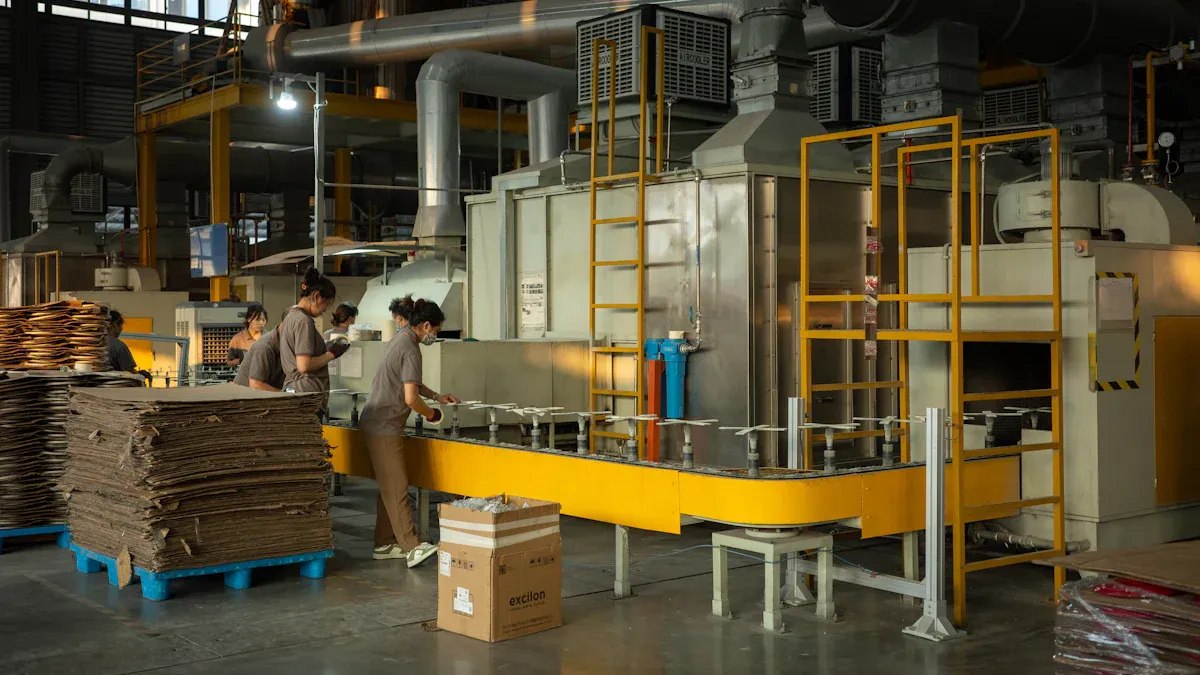
You need good machines to make corrugated boxes. The cost to make a box depends on the equipment you pick. A strong corrugated boxes maker machine for heavy things costs about $120,000. Here is a table with usual equipment prices:
Equipment Type | Price |
|---|---|
Rugged Corrugated Boxes Maker Machine | US$120,000 |
You can lease or buy your machines. Leasing means you pay less at first and can spend money on other things. Buying costs more at the start but saves money later. Pick what fits your budget and business needs.
Raw materials are a big part of your business costs. The average price for materials is $51 to $162 per unit. These prices change a lot and can affect your profits. Good inventory control helps keep your profits steady. When material prices go up, your costs rise too. For example, containerboard prices reached €165.95 per 1000 boxes when demand was high. Later, prices fell to €124.54 per 1000 boxes. Watch market prices to keep your business safe.
You need a place to make your boxes. Renting a warehouse costs $6 to $10 per square foot each year. Owning costs $12 to $15 per square foot and includes extra fees. Renting gives you more choices and lower starting costs. You can grow your space if you get more orders. Owning means you stay in one place and pay more at first. Leasing also lowers risks like market changes and repairs, since the landlord takes care of them.
Renting a warehouse in a good spot can cut transport costs and make customers happier.
You need to hire workers and get licenses for your business. Labor costs depend on how big your plant is and local pay rates. Licensing fees are different in each area. Add these costs to your business plan. Skilled workers help you make good boxes for many industries and meet customer needs.
You need to know how box size and material change your costs. Kraft paperboard costs more because it is strong and feels different. SBS white paperboard is cheaper since it uses recycled stuff. Bigger boxes cost more to ship and need more material. Picking the right size and material helps you save money and make more profit.
Here is a table that shows how size and material change the price for each box:
Size (L × W × H) | Single-Wall (Each) | Double-Wall (Each) |
|---|---|---|
Extra-Small (6" × 6" × 6") | $0.60–$0.70 | $0.80–$1.00 |
Small (12" × 9" × 4") | $0.70–$0.80 | $0.90–$1.20 |
Medium (18" × 14" × 12") | $1.75–$2.00 | $2.25–$2.75 |
Large (30" × 17" × 17") | $6.50–$7.00 | $8.45–$9.45 |
If you want eco-friendly packaging, you might pay more. But this can help you get customers who care about the environment.
Order volume is a big part of how much boxes cost. When you make more boxes, each one costs less. This is because you use machines better and waste less. You also save time and money.
Here is a table that shows how buying more boxes lowers the price for each one:
Order Quantity | Cost per Box | % Savings |
|---|---|---|
1–99 | $2.00 | — |
100–499 | $1.80 | ~10% |
500–999 | $1.60 | ~20% |
1,000+ | $1.50 | ~25% |
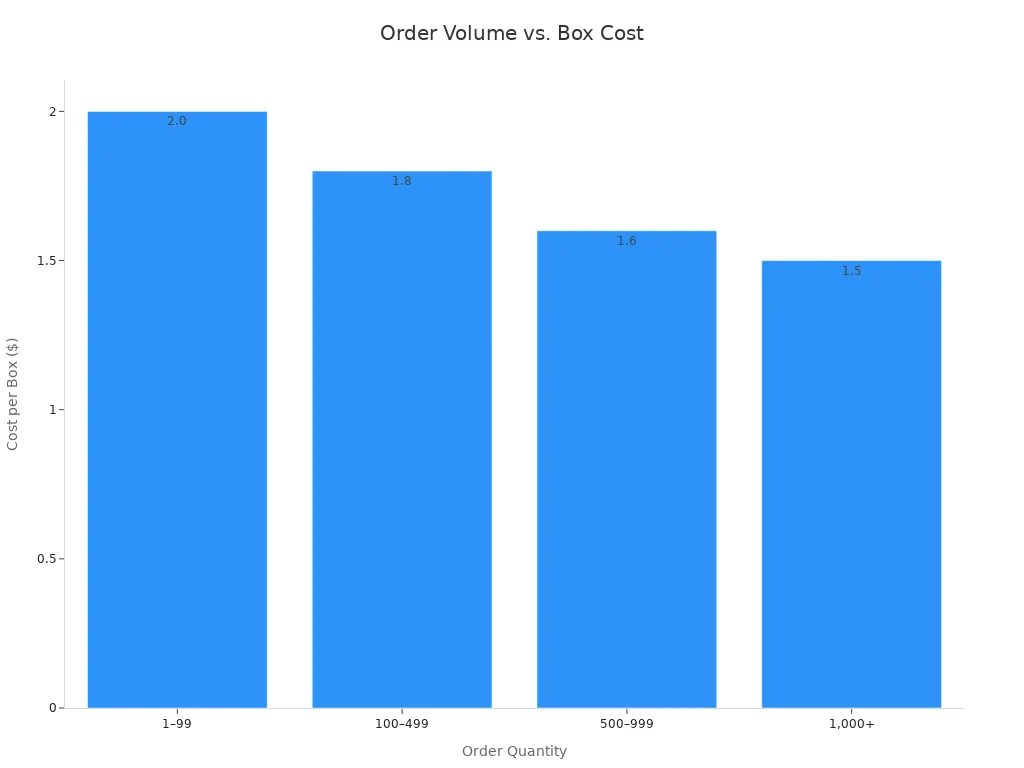
Buying in bulk helps you get better deals and steady prices. You order less often and plan your work better, which helps your business run well.
Custom boxes cost more if you want special sizes or printing. Special dies for custom sizes add extra costs. Artwork design can cost from $45 to $50,000, depending on how hard it is. Printing methods like digital, offset, and flexographic printing change the price. Add-ons like foil stamping, spot UV, embossing, or debossing can add $0.10 to $2.00 per box.
Here is a table that shows how finishing choices change the price:
Finishing Option | Description | Cost Impact |
|---|---|---|
Varnish | Good for small or medium jobs | Low to moderate |
Lamination | Protects designs, can cost more | Variable |
Wax Coatings | Stops water and grease, used for food or medical | Generally low |
No Coating | Cheapest choice | No additional cost |
Digital Printing: Good for small orders and bright colors.
Offset Printing: Best for big orders and high quality.
Flexographic Printing: Works well for lots of boxes.
Add-ons: Foil stamping, spot UV, embossing, or debossing can raise costs.
If you sell to e-commerce companies, they often want custom designs. You need to balance these features with your costs to stay competitive.
You can spend less at first by leasing equipment. Leasing needs little or no money down. This helps you keep cash for daily needs. Leasing lets you use machines before buying them. You can switch to better machines later. You also get tax breaks because lease payments are business costs.
But leasing can cost more in the long run. You do not own the equipment, so you give it back later. Sometimes, you must pay for repairs. Buying means you own the machines and can sell them, but you need more money at the start.
Leasing helps you save cash and stay flexible as your business grows.
You can make more money by picking materials carefully. Pick the smallest box that fits your product. Use cheaper materials that still keep things safe. Use the same box designs to save on custom costs.
Check your suppliers before you buy a lot. Test samples and start with small orders. Make sure your suppliers do a good job. Corrugated fiberboard protects your items and keeps costs low.
Buy lots of materials at once to get discounts. Make deals with suppliers for better prices. This table shows how supplier deals change material costs:
Evidence Type | Description |
|---|---|
Pricing Structure | Different suppliers have different prices. |
Cost Savings | Buying in bulk or making deals saves money. |
Picking the right way to buy materials helps you handle changes in demand and keeps your business strong.
Starting small helps you avoid big risks and control spending. You can grow bigger when you get more orders. Buying in bulk makes each box cheaper. Using the same sizes lowers shipping costs. Simple operations mean you run out of stock less and manage inventory better.
This table shows why growing your business can save money:
Description | |
|---|---|
Economies of Scale | Buying more lowers the cost for each box. |
Reduced Shipping Costs | Using standard sizes cuts extra shipping fees. |
Streamlined Operations | Better inventory helps you work faster and makes customers happy. |
Improved Inventory Management | Bulk packaging means less waste and better stock control. |
Start with a small setup. Grow as you get more orders. This way, you can change as your business needs grow.
Starting a corrugated box business takes good planning. How much you spend depends on plant size, how many machines you use, and what materials you pick. The world market is getting bigger because more people shop online and stores are growing. Look at the table below for important facts:
Aspect | Details |
|---|---|
Market Growth | USD 208.18 Billion in 2024 |
E-commerce Demand | USD 26.8 Trillion in 2024 |
Sustainability | Biodegradable packaging is in demand |
Customization | Lightweight, tamper-evident boxes needed |
Use this guide to help guess your costs. Ask suppliers about prices and check different machines to make a smart budget.
Pick recycled materials and use common box sizes.
Buy good machines and make lots of boxes at once.
Work with trusted manufacturers.
Make a careful plan for your business. Find ways to save money so you can compete and earn more.
You can expect profit margins between 10% and 20%. Your actual profit depends on your costs, box quality, and how many boxes you sell.
Tip: Track your expenses and sales to see where you can improve.
You need a corrugation machine, cutting machine, printing unit, and stitching machine.
Start with basic machines if you have a small budget.
Upgrade as your business grows.
Leasing helps you save cash at the start. Buying gives you full ownership.
Option | Upfront Cost | Flexibility |
|---|---|---|
Lease | Low | High |
Buy | High | Low |
Avoid buying too much raw material.
Do not skip getting the right licenses.
Always plan your budget and check supplier quality.

